Advertisements
Advertisements
Question
Prove that the diagonals of a rhombus are perpendicular bisectors of each other.
Advertisements
Solution
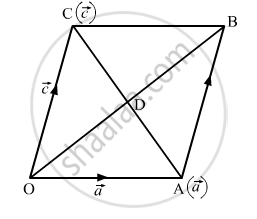
Let OABC be a rhombus, whose diagonals OB and AC intersect at D. Suppose O is the origin.
Let the position vector of A and C be \[\vec{a}\] and \[\vec{c}\] respectively.
Then, \[\vec{OA} = \vec{a}\]
In ∆OAB,
\[\vec{OB} = \vec{OA} + \vec{AB} = \vec{OA} + \vec{OC} = \vec{a} + \vec{c}\]..........\[\left( \vec{AB} = \vec{OC} \right)\]
Position vector of mid-point of \[\vec{OB} = \frac{1}{2}\left( \vec{a} + \vec{c} \right)\]
Position vector of mid-point of\[\vec{OB} = \frac{1}{2}\left( \vec{a} + \vec{c} \right)\]................(Mid-point formula)
So, the mid-points of OB and AC coincide. Thus, the diagonals OB and AC bisect each other.
Now,
\[\vec{OB} . \vec{AC} = \left( \vec{a} + \vec{c} \right) . \left( \vec{c} - \vec{a} \right)\]
\[ = \left( \vec{c} + \vec{a} \right) . \left( \vec{c} - \vec{a} \right)\]
\[ = \left| \vec{c} \right|^2 - \left| \vec{a} \right|^2 \]
\[ = \left| \vec{OC} \right|^2 - \left| \vec{OA} \right|^2 \]
\[ = 0 \left( \left| \vec{OC} \right| = \left| \vec{OA} \right| \right)\]
\[ \Rightarrow \vec{OB} \perp \vec{AC}\]
Hence, the diagonals OB and AC are perpendicular to each other.
Thus, the diagonals of a rhombus are perpendicular bisectors of each other.
APPEARS IN
RELATED QUESTIONS
If point C `(barc)` divides the segment joining the points A(`bara`) and B(`barb`) internally in the ratio m : n, then prove that `barc=(mbarb+nbara)/(m+n)`
Find the coordinate of the point P where the line through A(3, –4, –5) and B(2, –3, 1) crosses the plane passing through three points L(2, 2, 1), M(3, 0, 1) and N(4, –1, 0).
Also, find the ratio in which P divides the line segment AB.
In a triangle OAB,\[\angle\]AOB = 90º. If P and Q are points of trisection of AB, prove that \[{OP}^2 + {OQ}^2 = \frac{5}{9} {AB}^2\]
(Pythagoras's Theorem) Prove by vector method that in a right angled triangle, the square of the hypotenuse is equal to the sum of the squares of the other two sides.
Prove using vectors: The quadrilateral obtained by joining mid-points of adjacent sides of a rectangle is a rhombus.
If AD is the median of ∆ABC, using vectors, prove that \[{AB}^2 + {AC}^2 = 2\left( {AD}^2 + {CD}^2 \right)\]
Prove that the line segments joining the midpoints of the adjacent sides of a quadrilateral form a parallelogram.
If two of the vertices of a triangle are A (3, 1, 4) and B (– 4, 5, –3) and the centroid of the triangle is at G (–1, 2, 1), then find the coordinates of the third vertex C of the triangle.
Find the centroid of tetrahedron with vertices K(5, −7, 0), L(1, 5, 3), M(4, −6, 3), N(6, −4, 2)
The points A, B, C have position vectors `bar"a", bar"b" and bar"c"` respectively. The point P is the midpoint of AB. Find the vector `bar"PC"` in terms of `bar"a", bar"b", bar"c"`.
If D, E, F are the midpoints of the sides BC, CA, AB of a triangle ABC, prove that `bar(AD) + bar(BE) + bar(CF) = bar0`.
Prove that `(bar"a" xx bar"b").(bar"c" xx bar"d")` =
`|bar"a".bar"c" bar"b".bar"c"|`
`|bar"a".bar"d" bar"b".bar"d"|.`
If `bara, barb` and `barc` are position vectors of the points A, B, C respectively and `5bara - 3barb - 2barc = bar0`, then find the ratio in which the point C divides the line segement BA.
If G(a, 2, −1) is the centroid of the triangle with vertices P(1, 2, 3), Q(3, b, −4) and R(5, 1, c) then find the values of a, b and c
If A(5, 1, p), B(1, q, p) and C(1, −2, 3) are vertices of triangle and `"G"("r", -4/3, 1/3)` is its centroid then find the values of p, q and r
Prove that the angle bisectors of a triangle are concurrent
If A(1, 3, 2), B(a, b, - 4) and C(5, 1, c) are the vertices of triangle ABC and G(3, b, c) is its centroid, then
If the plane 2x + 3y + 5z = 1 intersects the co-ordinate axes at the points A, B, C, then the centroid of Δ ABC is ______.
Let G be the centroid of a Δ ABC and O be any other point in that plane, then OA + OB + OC + CG = ?
In a quadrilateral ABCD, M and N are the mid-points of the sides AB and CD respectively. If AD + BC = tMN, then t = ____________.
If G(3, -5, r) is centroid of triangle ABC where A(7, - 8, 1), B(p, q, 5) and C(q + 1, 5p, 0) are vertices of a triangle then values of p, q, rare respectively.
If the orthocentre and circumcentre of a triangle are (-3, 5, 1) and (6, 2, -2) respectively, then its centroid is ______
In ΔABC, P is the midpoint of BC, Q divides CA internally in the ratio 2:1 and R divides AB externally in the ratio 1:2, then ______.
Find the unit vector in the diret:tion of the vector `veca = hati + hatj + 2hatk`
What is the midpoint of the vector joining the point P(2, 3, 4) and Q(4, 1, –2)?
M and N are the mid-points of the diagonals AC and BD respectively of quadrilateral ABCD, then AB + AD + CB + CD is equal to ______.
If `overlinea, overlineb, overlinec` are the position vectors of the points A, B, C respectively and `5overlinea + 3overlineb - 8overlinec = overline0` then find the ratio in which the point C divides the line segment AB.
If `bara, barb` and `barr` are position vectors of the points A, B and R respectively and R divides the line segment AB externally in the ratio m : n, then prove that `barr = (mbarb - nbara)/(m - n)`.
AB and CD are two chords of a circle intersecting at right angles to each other at P. If R is the centre of the circle, prove that:
`bar(PA) + bar(PB) + bar(PC) + bar(PD) = 2bar(PR)`
The position vector of points A and B are `6bara + 2barb` and `bara - 3barb`. If the point C divides AB in the ratio 3 : 2, then show that the position vector of C is `3bara - barb`.
The position vector of points A and B are `6 bara + 2barb and bara - 3barb.` If the point C divides AB in the ratio 3 : 2 then show that the position vector of C is `3bara - barb.`
The position vector of points A and B are 6`bara + 2barb and bara - 3barb`. If the point C divides AB in the ratio 3 : 2 then show that the position vector of C is 3`bara - barb`.
