मराठी

Prove that the Diagonals of a Rhombus Are Perpendicular Bisectors of Each Other. - Mathematics

Advertisements
Advertisements

प्रश्न

Prove that the diagonals of a rhombus are perpendicular bisectors of each other. 

बेरीज
Advertisements

उत्तर


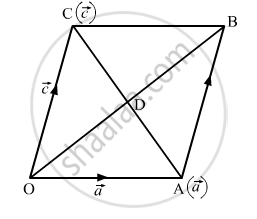
Let OABC be a rhombus, whose diagonals OB and AC intersect at D. Suppose O is the origin.

Let the position vector of A and C be  \[\vec{a}\] and \[\vec{c}\] respectively. 

Then, \[\vec{OA} = \vec{a}\]

In ∆OAB,

\[\vec{OB} = \vec{OA} + \vec{AB} = \vec{OA} + \vec{OC} = \vec{a} + \vec{c}\]..........\[\left( \vec{AB} = \vec{OC} \right)\]

Position vector of mid-point of \[\vec{OB} = \frac{1}{2}\left( \vec{a} + \vec{c} \right)\]  

Position vector of mid-point of\[\vec{OB} = \frac{1}{2}\left( \vec{a} + \vec{c} \right)\]................(Mid-point formula) 

So, the mid-points of OB and AC coincide. Thus, the diagonals OB and AC bisect each other. 

Now, 

\[\vec{OB} . \vec{AC} = \left( \vec{a} + \vec{c} \right) . \left( \vec{c} - \vec{a} \right)\]
\[ = \left( \vec{c} + \vec{a} \right) . \left( \vec{c} - \vec{a} \right)\]
\[ = \left| \vec{c} \right|^2 - \left| \vec{a} \right|^2 \]
\[ = \left| \vec{OC} \right|^2 - \left| \vec{OA} \right|^2 \]
\[ = 0 \left( \left| \vec{OC} \right| = \left| \vec{OA} \right| \right)\]
\[ \Rightarrow \vec{OB} \perp \vec{AC}\] 

Hence, the diagonals OB and AC are perpendicular to each other.

Thus, the diagonals of a rhombus are perpendicular bisectors of each other. 


shaalaa.com
  या प्रश्नात किंवा उत्तरात काही त्रुटी आहे का?
पाठ 24: Scalar Or Dot Product - Exercise 24.2 [पृष्ठ ४६]

APPEARS IN

आरडी शर्मा Mathematics [English] Class 12
पाठ 24 Scalar Or Dot Product
Exercise 24.2 | Q 6 | पृष्ठ ४६

व्हिडिओ ट्यूटोरियलVIEW ALL [2]

संबंधित प्रश्‍न

If  `bar p = hat i - 2 hat j + hat k and bar q = hat i + 4 hat j - 2 hat k` are position vector (P.V.) of points P and Q, find the position vector of the point R which divides segment PQ internally in the ratio 2:1


By vector method prove that the medians of a triangle are concurrent.


If the origin is the centroid of the triangle whose vertices are A(2, p, –3), B(q, –2, 5) and C(–5, 1, r), then find the values of p, q, r.


In a triangle OAB,\[\angle\]AOB = 90º. If P and Q are points of trisection of AB, prove that \[{OP}^2 + {OQ}^2 = \frac{5}{9} {AB}^2\]


Prove by vector method that the sum of the squares of the diagonals of a parallelogram is equal to the sum of the squares of its sides.


Prove that the diagonals of a rectangle are perpendicular if and only if the rectangle is a square. 


If AD is the median of ∆ABC, using vectors, prove that \[{AB}^2 + {AC}^2 = 2\left( {AD}^2 + {CD}^2 \right)\] 


If the median to the base of a triangle is perpendicular to the base, then triangle is isosceles. 


In Δ OAB, E is the midpoint of OB and D is the point on AB such that AD : DB = 2 : 1. If OD and AE intersect at P, then determine the ratio OP : PD using vector methods.


Find the centroid of tetrahedron with vertices K(5, −7, 0), L(1, 5, 3), M(4, −6, 3), N(6, −4, 2)


If `bara, barb` and `barc` are position vectors of the points A, B, C respectively and `5bara - 3barb - 2barc = bar0`, then find the ratio in which the point C divides the line segement BA.


If A(5, 1, p), B(1, q, p) and C(1, −2, 3) are vertices of triangle and `"G"("r", -4/3, 1/3)` is its centroid then find the values of p, q and r


Prove that medians of a triangle are concurrent


Prove that altitudes of a triangle are concurrent


Using vector method, find the incenter of the triangle whose vertices are A(0, 3, 0), B(0, 0, 4) and C(0, 3, 4)


If the plane 2x + 3y + 5z = 1 intersects the co-ordinate axes at the points A, B, C, then the centroid of Δ ABC is ______.


Let G be the centroid of a Δ ABC and O be any other point in that plane, then OA + OB + OC + CG = ?


In a triangle ABC, if `1/(a + c) + 1/(b + c) = 3/(a + b + c)` then angle C is equal to ______


If G(3, -5, r) is centroid of triangle ABC where A(7, - 8, 1), B(p, q, 5) and C(q + 1, 5p, 0) are vertices of a triangle then values of p, q, rare respectively.


P is the point of intersection of the diagonals of the parallelogram ABCD. If O is any point, then `overline"OA" + overline"OB" + overline"OC" + overline"OD"` = ______ 


If the position vectors of points A and B are `hati + 8hatj + 4hatk` and `7hati + 2hatj - 8hatk`, then what will be the position vector of the midpoint of AB?


If `3bar"a" + 5bar"b" = 8bar"c"`, then A divides BC in tbe ratio ______.


If A, B, C are the vertices of a triangle whose position vectors are `overline("a"),overline("b"),overline("c")` and G is the centroid of the `triangle ABC,` then `overline("GA")+overline("GB")+overline("GC")` is ______.


Let `square`PQRS be a quadrilateral. If M and N are midpoints of the sides PQ and RS respectively then `bar"PS" + bar"OR"` = ______.


Find the unit vector in the diret:tion of the vector `veca = hati + hatj + 2hatk`


What is the midpoint of the vector joining the point P(2, 3, 4) and Q(4, 1, –2)?


If D, E, F are the mid points of the sides BC, CA and AB respectively of a triangle ABC and 'O' is any point, then, `|vec(AD) + vec(BE) + vec(CF)|`, is ______.


M and N are the mid-points of the diagonals AC and BD respectively of quadrilateral ABCD, then AB + AD + CB + CD is equal to ______.


If G(g), H(h) and (p) are centroid orthocentre and circumcentre of a triangle and xp + yh + zg = 0, then (x, y, z) is equal to ______.


If `overlinea, overlineb, overlinec` are the position vectors of the points A, B, C respectively and `5overlinea + 3overlineb - 8overlinec = overline0` then find the ratio in which the point C divides the line segment AB.


The position vectors of three consecutive vertices of a parallelogram ABCD are `A(4hati + 2hatj - 6hatk), B(5hati - 3hatj + hatk)`, and `C(12hati + 4hatj + 5hatk)`. The position vector of D is given by ______.


The position vector of points A and B are `6 bar "a" + 2 bar "b" and bar "a" - 3 bar"b"`. If the point C divided AB in the ratio 3 : 2, show that the position vector of C is `3 bar "a" - bar "b".`


Find the ratio in which the point C divides segment AB, if `5bara + 4barb - 9barc = bar0`


The position vector of points A and B are `6bara + 2 barb` and `bara-3 barb`. If the point C divides AB in the ratio 3 : 2 then show that the position vector of C is `3bara -barb`.


The position vector of points A and B are `6 bara + 2barb and bara - 3barb.` If the point C divides AB in the ratio 3 : 2 then show that the position vector of C is `3bara - barb.`


Share
Notifications

Englishहिंदीमराठी


      Forgot password?
Use app×