Advertisements
Advertisements
Question
Prove that `(1 + sin B)/(cos B) + (cos B)/(1 + sin B) = 2 sec B`.
Advertisements
Solution
L.H.S = `(1 + sin B)/(cos B) + (cos B)/(1 + sin B)`
= `((1 + sin B)^2 + cos^2B)/(cos B(1 + sin B))`
= `(1 + 2 sin B + sin^2B + cos^2B)/(cos B(1 + sin B))` ...[∵ (a + b)2 = a2 + 2ab + b2]
= `(1 + 2 sin B + 1)/(cos B(1 + sin B))` ...[∵ sin2B + cos2B = 1]
= `(2 + 2 sin B)/(cos B(1 + sin B))`
= `(2(1 + sin B))/(cos B(1 + sin B))`
= `2/(cos B)`
= 2 sec B
= R.H.S.
∴ `(1 + sin B)/(cos B) + (cos B)/(1 + sin B) = 2 sec B`
APPEARS IN
RELATED QUESTIONS
Express the ratios cos A, tan A and sec A in terms of sin A.
Prove the following identities, where the angles involved are acute angles for which the expressions are defined:
`(sin theta-2sin^3theta)/(2cos^3theta -costheta) = tan theta`
Prove the following trigonometric identities:
`(1 - cos theta)/sin theta = sin theta/(1 + cos theta)`
Prove the following trigonometric identities.
sin2 A cos2 B − cos2 A sin2 B = sin2 A − sin2 B
Write the value of `4 tan^2 theta - 4/ cos^2 theta`
If `tan theta = 1/sqrt(5), "write the value of" (( cosec^2 theta - sec^2 theta))/(( cosec^2 theta - sec^2 theta))`.
From the figure find the value of sinθ.
Write the value of \[\cot^2 \theta - \frac{1}{\sin^2 \theta}\]
What is the value of \[\frac{\tan^2 \theta - \sec^2 \theta}{\cot^2 \theta - {cosec}^2 \theta}\]
If \[\cos \theta = \frac{3}{4}\] then find the value of 9 tan2 θ + 9.
If cosec2 θ (1 + cos θ) (1 − cos θ) = λ, then find the value of λ.
Write 'True' or 'False' and justify your answer in the following:
The value of \[\sin \theta\] is \[x + \frac{1}{x}\], where 'x' is a positive real number.
Prove the following identity:
tan2A − sin2A = tan2A · sin2A
Prove the following identity :
`(cosecA - sinA)(secA - cosA)(tanA + cotA) = 1`
Prove the following identity :
`1/(cosA + sinA - 1) + 2/(cosA + sinA + 1) = cosecA + secA`
Without using trigonometric table , evaluate :
`cosec49°cos41° + (tan31°)/(cot59°)`
Prove that sin (90° - θ) cos (90° - θ) = tan θ. cos2θ.
Prove the following identities.
(sin θ + sec θ)2 + (cos θ + cosec θ)2 = 1 + (sec θ + cosec θ)2
If 2 cos θ + sin θ = `1(θ ≠ π/2)`, then 7 cos θ + 6 sin θ is equal to ______.
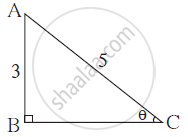
Find the value of sin2θ + cos2θ

Solution:
In Δ ABC, ∠ABC = 90°, ∠C = θ°
AB2 + BC2 = `square` .....(Pythagoras theorem)
Divide both sides by AC2
`"AB"^2/"AC"^2 + "BC"^2/"AC"^2 = "AC"^2/"AC"^2`
∴ `("AB"^2/"AC"^2) + ("BC"^2/"AC"^2) = 1`
But `"AB"/"AC" = square and "BC"/"AC" = square`
∴ `sin^2 theta + cos^2 theta = square`
