Advertisements
Advertisements
Question
Prove geometrically that when plane mirror turns through a certain angle, the reflected ray turns through twice the angle.
Advertisements
Solution
Consider a ray of light AB, incident on a plane mirror in position MM’, such that BC is the reflected ray and BN is normal.
∠ABM = ∠CBN = ∠i
∠ABC = 2 ∠i …(i)
Let the mirror be rotated through an angle ‘0’ about point B, such that M1M1 is the new position of the mirror and BN1 is the new position of normal. As the position of the incident ray remains same, therefore new angle of the incidence is ∠ABN1 whose magnitude is (i + θ). Let BD be the reflected ray, such that ∠DNB1 is the new angle of reflection.
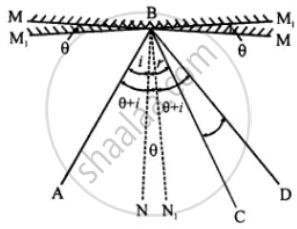
∠ABD = ∠ABN1 + ∠DBN1
= ∠(i + θ) + ∠(i + θ)
= 2 ∠i + 2∠θ
Subtracting (i) from (ii)
∠ABD - ∠ABC = 2∠i + 2∠θ - 2∠i
∴ ∠CBD = 2∠θ
Thus, for a given incident ray, if the plane mirror is rotated through a certain angle, then the reflected ray rotates through twice the angle.
APPEARS IN
RELATED QUESTIONS
Fill in the blank
A ________ image cannot be obtained on a screen.
Select the correct alternative
The angle between the incident ray and the ray reflected from the plane mirror is 70°. The angle of incidence will be :
The image formed by a plane mirror is :
An object is kept at 60 cm in front of a plane mirror. If the mirror is now moved 25 cm away from the object, how does the image shift from its previous position?
Explain the following term:
Normal Draw
diagram/diagrams to show them.
Calculate the number of images formed in two plane mirrors, when they are held at the angle of (i) 72° (ii) 36°.
An insect is sitting in front of a plane mirror at a distance of one meter from it.
- Where is the image of insect formed?
- What is the distance between insect and its image?
- State any two characteristics of image formed in a plane mirror.
Select the correct option:
If an incident ray passes through the centre of curvature of a spherical mirror, the reflected ray will:
Identify the following kind of beam of light.