Advertisements
Advertisements
Question
Prove experimentally that images are formed as far behind in a plane mirror as the object is in front of it.
Advertisements
Solution
Consider an object ‘O’ situated in front of a plane mirror MM, A ray of light which starts from point ‘O’ perpendicularly, is reflected back along the same path (See the following figure).
However, another ray that moves along OB is reflected along with BC, obeying the laws of reflection, such that BN is normal. Produce OA and CB backward, such that they meet at a point I. Then ‘I’ is the image of ‘O’.
We have to prove that OA = IA
∠i = ∠r [By the laws of reflection] ...(i)
Also, ∠i = ∠l [Pair of alternate angles] ...(ii)
∠r = ∠2 [Pair of corresponding angles]
Comparing (i) and (ii), ∴ ∠l = ∠2
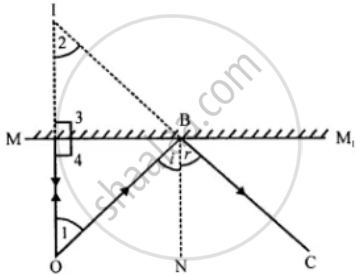
In ΔBAI and BAO
∠1 = ∠2 [Proved]
∠3 = ∠4 [Each = 90°]
BA = BA [Common to both Δs]
∴ ΔBAI ≅ ΔBAO
Thus, in particular OA = IA.
APPEARS IN
RELATED QUESTIONS
Write three characteristics of the image formed by a plane mirror?
Why is it difficult to read the image of the text of a page formed due to reflection by a plane mirror?
The image formed by a plane mirror is :
Two plane mirrors are arranged parallel and facing each other at some separation. How many images are formed for a point object kept in between them? Show the formation of images with the help of a ray diagram
An object is placed (i) asymmetrically (ii) symmetrically, between two plane mirrors inclined at an angle of 50°. Find the number of images formed.
Calculate the number of images formed in two plane mirrors, when they are held at the angle of (i) 72° (ii) 36°.
What should be the minimum size of a plane mirror, so that a person 182 cm high can see himself completely?
Select the correct option:
A ray of light is incident on a concave mirror. If it is parallel to principal axis, the reflected ray will:
Select the correct option:
In case of concave mirror, the minimum distance between an object and its real image is:
