Advertisements
Advertisements
प्रश्न
Prove geometrically that when plane mirror turns through a certain angle, the reflected ray turns through twice the angle.
Advertisements
उत्तर
Consider a ray of light AB, incident on a plane mirror in position MM’, such that BC is the reflected ray and BN is normal.
∠ABM = ∠CBN = ∠i
∠ABC = 2 ∠i …(i)
Let the mirror be rotated through an angle ‘0’ about point B, such that M1M1 is the new position of the mirror and BN1 is the new position of normal. As the position of the incident ray remains same, therefore new angle of the incidence is ∠ABN1 whose magnitude is (i + θ). Let BD be the reflected ray, such that ∠DNB1 is the new angle of reflection.
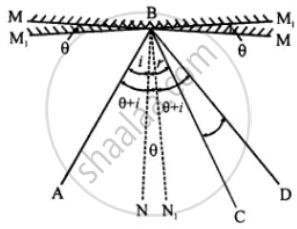
∠ABD = ∠ABN1 + ∠DBN1
= ∠(i + θ) + ∠(i + θ)
= 2 ∠i + 2∠θ
Subtracting (i) from (ii)
∠ABD - ∠ABC = 2∠i + 2∠θ - 2∠i
∴ ∠CBD = 2∠θ
Thus, for a given incident ray, if the plane mirror is rotated through a certain angle, then the reflected ray rotates through twice the angle.
APPEARS IN
संबंधित प्रश्न
Write three characteristics of the image formed by a plane mirror?
A man standing in front of a plane mirror finds his image at a distance 6 metre from himself. What is the distance of man from the mirror?
An insect is sitting in front of a plane mirror at a distance 1 m from it.
(a) Where is the image of the insect formed?
An insect is sitting in front of a plane mirror at a distance 1 m from it.
(b) What is the distance between the insect and its image?
How many images are formed for a point object kept in between two plane mirrors at right angles to each other? Show them by drawing a ray diagram.
Prove experimentally that images are formed as far behind in a plane mirror as the object is in front of it.
(a) What do you understand by the term lateral inversion?
(b) A printed card has letters PHYSICS. By drawing the diagram show the appearance of the letters. (No ray diagram is required).
An insect is sitting in front of a plane mirror at a distance of one meter from it.
- Where is the image of insect formed?
- What is the distance between insect and its image?
- State any two characteristics of image formed in a plane mirror.
Select the correct option:
A ray of light is incident on a concave mirror. If it is parallel to principal axis, the reflected ray will:
