Advertisements
Advertisements
Question
An insect is sitting in front of a plane mirror at a distance of one meter from it.
- Where is the image of insect formed?
- What is the distance between insect and its image?
- State any two characteristics of image formed in a plane mirror.
Advertisements
Solution
(i) Distance of insect from plane mirror = u = 1 m
We know in the case of plane mirror, distance of object from plane mirror is equal to distance of image of the object from the plane mirror.
∴Distance of the image of insect from plane mirror = v = u – 1 m
(ii) Distance between insect and its image = u + v = 1 + 1 = 2 m
(iii) Characteristics of the image formed by a plane mirror :
(a) Image formed is virtual.
(b) Image formed is erect.
(c) Image formed is of same size as that of the object.
APPEARS IN
RELATED QUESTIONS
Fill in the blank
A ________ image cannot be obtained on a screen.
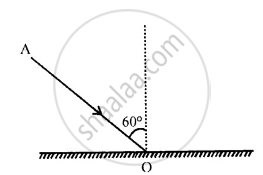
The diagram in fig. shows an incident ray AO and the normal ON on a plane mirror. Draw the reflected ray. State the law you use to draw the direction of the reflected ray.
An optician while testing the eyes of a patient keeps a chart of letters 3 m behind the patient and asks him to see the letters on the image of chart formed in a plane mirror kept at distance 2 m in front of him. At what distance is the chart seen by the patient?
How many images are formed for a point object kept in between two plane mirrors at right angles to each other? Show them by drawing a ray diagram.
In the barber's shop, two plane mirrors are placed :
Prove experimentally that images are formed as far behind in a plane mirror as the object is in front of it.
(a) What do you understand by the term lateral inversion?
(b) A printed card has letters PHYSICS. By drawing the diagram show the appearance of the letters. (No ray diagram is required).
Draw a neat two ray diagram for the formation of images in two plane mirrors, when mirrors are at right angles to each other.
Select the correct option:
In case of concave mirror, the minimum distance between an object and its real image is:
