Advertisements
Advertisements
Question
Prove the following by using the principle of mathematical induction for all n ∈ N:
Advertisements
Solution
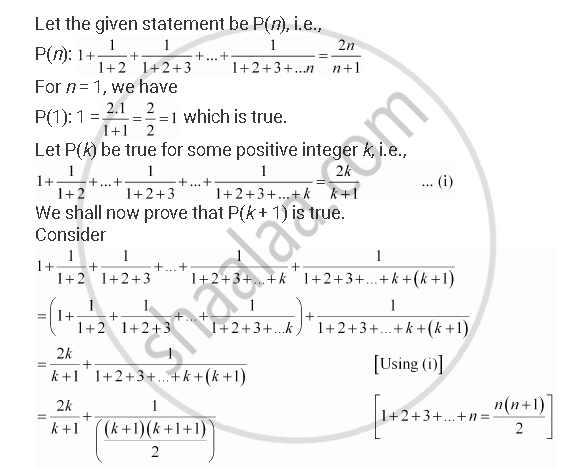
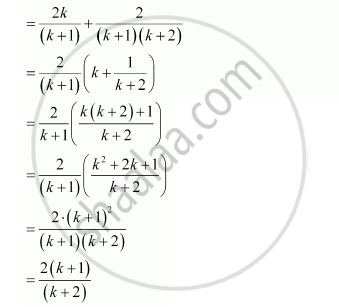
Thus, P(k + 1) is true whenever P(k) is true.
Hence, by the principle of mathematical induction, statement P(n) is true for all natural numbers i.e., n.
RELATED QUESTIONS
Prove the following by using the principle of mathematical induction for all n ∈ N:
1.2 + 2.3 + 3.4+ ... + n(n+1) = `[(n(n+1)(n+2))/3]`
Prove the following by using the principle of mathematical induction for all n ∈ N:
(1+3/1)(1+ 5/4)(1+7/9)...`(1 + ((2n + 1))/n^2) = (n + 1)^2`
Prove the following by using the principle of mathematical induction for all n ∈ N: x2n – y2n is divisible by x + y.
If P (n) is the statement "n3 + n is divisible by 3", prove that P (3) is true but P (4) is not true.
If P (n) is the statement "n2 + n is even", and if P (r) is true, then P (r + 1) is true.
\[\frac{1}{1 . 2} + \frac{1}{2 . 3} + \frac{1}{3 . 4} + . . . + \frac{1}{n(n + 1)} = \frac{n}{n + 1}\]
\[\frac{1}{2 . 5} + \frac{1}{5 . 8} + \frac{1}{8 . 11} + . . . + \frac{1}{(3n - 1)(3n + 2)} = \frac{n}{6n + 4}\]
\[\frac{1}{3 . 5} + \frac{1}{5 . 7} + \frac{1}{7 . 9} + . . . + \frac{1}{(2n + 1)(2n + 3)} = \frac{n}{3(2n + 3)}\]
\[\frac{1}{3 . 7} + \frac{1}{7 . 11} + \frac{1}{11 . 5} + . . . + \frac{1}{(4n - 1)(4n + 3)} = \frac{n}{3(4n + 3)}\]
\[\frac{1}{2} + \frac{1}{4} + \frac{1}{8} + . . . + \frac{1}{2^n} = 1 - \frac{1}{2^n}\]
32n+2 −8n − 9 is divisible by 8 for all n ∈ N.
n(n + 1) (n + 5) is a multiple of 3 for all n ∈ N.
72n + 23n−3. 3n−1 is divisible by 25 for all n ∈ N.
Let P(n) be the statement : 2n ≥ 3n. If P(r) is true, show that P(r + 1) is true. Do you conclude that P(n) is true for all n ∈ N?
\[\text{ Given } a_1 = \frac{1}{2}\left( a_0 + \frac{A}{a_0} \right), a_2 = \frac{1}{2}\left( a_1 + \frac{A}{a_1} \right) \text{ and } a_{n + 1} = \frac{1}{2}\left( a_n + \frac{A}{a_n} \right) \text{ for } n \geq 2, \text{ where } a > 0, A > 0 . \]
\[\text{ Prove that } \frac{a_n - \sqrt{A}}{a_n + \sqrt{A}} = \left( \frac{a_1 - \sqrt{A}}{a_1 + \sqrt{A}} \right) 2^{n - 1} .\]
Prove by method of induction, for all n ∈ N:
12 + 32 + 52 + .... + (2n − 1)2 = `"n"/3 (2"n" − 1)(2"n" + 1)`
Prove by method of induction, for all n ∈ N:
(23n − 1) is divisible by 7
Prove by method of induction, for all n ∈ N:
(24n−1) is divisible by 15
Prove by method of induction, for all n ∈ N:
5 + 52 + 53 + .... + 5n = `5/4(5^"n" - 1)`
Answer the following:
Given that tn+1 = 5tn − 8, t1 = 3, prove by method of induction that tn = 5n−1 + 2
Answer the following:
Prove by method of induction 152n–1 + 1 is divisible by 16, for all n ∈ N.
A student was asked to prove a statement P(n) by induction. He proved that P(k + 1) is true whenever P(k) is true for all k > 5 ∈ N and also that P(5) is true. On the basis of this he could conclude that P(n) is true ______.
Give an example of a statement P(n) which is true for all n ≥ 4 but P(1), P(2) and P(3) are not true. Justify your answer
Prove the statement by using the Principle of Mathematical Induction:
23n – 1 is divisible by 7, for all natural numbers n.
Prove the statement by using the Principle of Mathematical Induction:
n3 – 7n + 3 is divisible by 3, for all natural numbers n.
Prove the statement by using the Principle of Mathematical Induction:
32n – 1 is divisible by 8, for all natural numbers n.
Prove the statement by using the Principle of Mathematical Induction:
For any natural number n, xn – yn is divisible by x – y, where x and y are any integers with x ≠ y.
Prove the statement by using the Principle of Mathematical Induction:
n(n2 + 5) is divisible by 6, for each natural number n.
Prove the statement by using the Principle of Mathematical Induction:
1 + 5 + 9 + ... + (4n – 3) = n(2n – 1) for all natural numbers n.
Prove that, cosθ cos2θ cos22θ ... cos2n–1θ = `(sin 2^n theta)/(2^n sin theta)`, for all n ∈ N.
If xn – 1 is divisible by x – k, then the least positive integral value of k is ______.
