Advertisements
Advertisements
Question
Out of HCl and CH3COOH, which one is a weak acid and why? Describe an activity to support your answer.
Advertisements
Solution
CH3COOH is a weak acid when compared to HCl because HCl completely dissociates into ions in solution whereas CH3COOH being weak acid is partially dissociated into ions in solution.
This can be proved by the following activity:
Two iron nails are fitted on a cork and are kept in a 100 mL beaker. The nails are then connected to the two terminals of a 6-volt battery through a bulb and a switch. Some dilute HCl is poured in the beaker and the current is switched on. The same experiment is then performed with CH3COOH.
Observations:
It will be observed that the bulb glows in the HCl solution and does not glow in the CH3COOH solution.
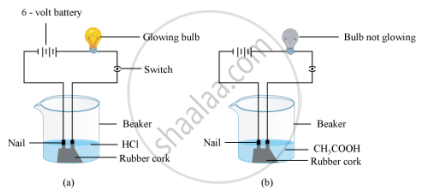 Inference:
HCl, being a strong acid dissociates into H+ and Cl− ions. These ions conduct electricity in the solution resulting in the glowing of the bulb. On the other hand, the CH3COOH is a weak acid. It does not dissociate into ions completely in solution. Therefore, it does not conduct electricity.
APPEARS IN
RELATED QUESTIONS
Give two examples of organic acids.
Which chemical is injected into the skin of a person during the nettle leaf hair sting?
How can the effect of this sting be neutralised?
What happens when bases react with non-metal oxides? Explain with the help of an example. What does this reaction tell us about the nature of non-metal oxides?
- What do you understand by the term, acid?
- Name the positive ion formed when an acid is dissolved in water.
- Draw the structure of this ion.
Water is never added to acid in order to dilute it why?
Acid mixed with base forms ______.
Hydrochloric Acid reacts with metal bicarbonates to give ______.
Which of the following metal does not react with sodium hydroxides?
Name the acid present in grapes.
Consider the acidity of the carboxylic acids:
(1) PhCOOH
(2) o-NO2C6H4COOH
(3) p-NO2C6H4COOH
(4) m-NO2C6H4COOH
