Advertisements
Advertisements
Question
One cannot always get what one wants and sometimes it is for the best. Present your reflections on this statement.
Advertisements
Solution
Life is a journey filled with the interplay of "fulfilled expectations" and "unfulfilled expectations." This delicate balance is governed by the circumstantial laws that shape our aspirations. While humans naturally aspire to achieve much, success is never guaranteed, and failures are not the end but often blessings in disguise.
Consider the story of Edison, whose factory was engulfed in flames. Instead of succumbing to despair, he perceived it as an opportunity for greater things. This resilient attitude, the ability to see setbacks as stepping stones, is the key to progress. If every desire were easily fulfilled, the elation of success would lose its meaning, and complacency might hinder our growth potential.
Setbacks in life are character tests, and as the saying goes, it's not about how many times we fall but how many times we rise. Facing failure cultivates strength of character, patience, empathy, and a holistic understanding of life. It teaches us to navigate the highs and lows with equanimity.
Fulfilling every desire is neither possible nor practical. Like a child whose every whim is indulged, such a person might lack the resilience needed to weather life's storms. The sudden burst of the fantasy bubble can be a profound shock, leading to challenges in finding one's bearings.
Rudyard Kipling's timeless words resonate here: "If you can meet triumph and disaster / And treat those impostors just the same." These words underscore the essence of navigating life's uncertainties with grace, whether in times of success or failure. The ability to face both triumph and disaster with equanimity defines true strength of character—a strength that enables us to claim our place in the world and, as Kipling concludes, to be a "Man, my son!"
APPEARS IN
RELATED QUESTIONS
Fill in the blank with the suitable word.
She turned _____________ the offer to work at the factory.
What are the five words used in the poem to describe the role of a middle-aged woman?
What is the activity referred to later in the poem, that sharpens their brains?
Whose dirty looks are referred to?
(A) Ramesh said, "Rajiv, please bring your physics book to school tomorrow."
(B) Ramesh………………………….
Break time (recess) at your school is only for a duration of fifteen minutes. Write a letter to your Principal requesting an extension in the break-time from fifteen minutes to half an hour. Give reasons for your request and explain in what way an extended break would make a difference to you as a student.
The following three compound words end in-ship. What does each of them mean?
| airship | flagship | lightship |
The sound words
(i) Contrast the Chinese view of art with the European view, with examples.
(ii) Explain the concept of shanshui.
How does the bond of affection between Mrs. Croft and the narrator evolve?
Your teacher will speak the word given below. Write against two new words that rhyme with it.
bed ______ ______
Multiple Choice Question:
What does the phrase in the extract ‘turned black’ mean here?
Given below are the prerequisites for an interview. Fill up the boxes with suitable actions to be undertaken with reference to the given points.

Complete the table. One is done for you.
| The World around you | What we should aim to be | |
| 1. | Callous | Caring for people, environment, life |
| 2. | Violent | |
| 3. | Greedy | |
| 4. | Corrupt |
Interpret the following lines in simple English.
Puck: I’ll follow you.
Bottom: The Finch, the sparrow.
Write what you think about the following thoughts and actions of Mathilde :
Mathilde did not tell her friend about the loss and replacement.
Write about your feelings and reactions in 4-5 lines.
You may describe your feelings and reactions using other words than those given here
Form groups of 5-8. Prepare short autobiographical speeches for each of these animals (10-15 lines). Use the following points :
- How the animal lives - It’s the only way he/she can.
- How he interacts with nature and other animals.
- How humans interact with that species - whether it is fair, necessary, or desirable, etc.
- The possible ill effects of the way human beings treat the animals, for the whole living world.
- The animal getting ready to bid farewell to this world.
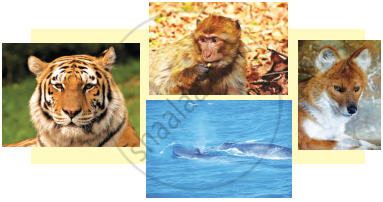
Write your opinion, in your own words:-
What did the aunt fail to realize in Bertha’s story?
Form groups and discuss each element of planning an interview and prepare notes on each element.
- Format - Structure: ......................
- Size/Length - How much: ......................
- Do’s and Dont’s - Rules and Regulations: ......................
- Type of Questions - Yes/No questions or Wh Type: ......................
Write a short paragraph describing the life and work of Mary Kom. Take help of the points given below.
- Early life
- Training
- Achievements
- Future plans
Answer the following questions in a paragraph about 80 -100 words
It is said, “The choices made by one, shape one’s destiny”. Ponder on the thought and write a paragraph.
Have you experienced any unexpected turn of events in your life? What happened? How did you feel about it at that moment? How do you feel about it now?
Write an article for your school magazine describing your experience in about 150 words.
“The Himalayas are the highest mountain ranges.” He knew that the Himalayas ______ the highest mountain ranges.
Now complete the following suitably.
_______ a dog ran out onto the road.
A crab has a hard shell whereas a frog does not have one. There are many animals that protect themselves from their enemies with their outer cover/shells/quills.
In the box given below are the names of some animals. Encircle the ones that can protect themselves with their hard cover.
| crocodile | snail | lizard | snake |
| turtle | tortoise | gorilla | frog |
| hedgehog | porcupine | - | - |
Now paste/draw the picture of anyone's animal. Write five lines about it.
Fill in the blanks according to the example given below
| tiny | tinier | tiniest |
| big | ______ | biggest |
| sleepy | sleepier | ______ |
| ______ | lovelier | loveliest |
| ______ | later | ______ |
| round | ______ | ______ |
| small | ______ | ______ |
| good | ______ | best |
Why was Mary Kom named the ‘Queen of Boxing’ and ‘Magnificent Mary'?
Write a composition in approximately 350 – 400 words on the following subject:
(You are reminded that you will be rewarded for orderly and coherent presentation of material, use of appropriate style and general accuracy of spelling, punctuation, and grammar.)
International sports promote friendship between nations.
Argue FOR or AGAINST the given statement.
What reason does Portia give for refusing the Duke's invitation to dinner?
