Advertisements
Advertisements
Question
On the set of natural numbers let R be the relation defined by aRb if 2a + 3b = 30. Write down the relation by listing all the pairs. Check whether it is equivalence
Advertisements
Solution
Given N = set of natural numbers
R is the relation defined by a R b if 2a + 3b = 30
3b = 30 – 2a ⇒ b = `(30 - 2a)/3` a, b ∈ N
a = 1, b = `(30 - 2)/3 = 28/3 ∉ "N"`
a = 2, b = `(30 - 4)/3 = 26/3 ∉ "N"`
a = 3, b = `(30 - 6)/3 = 24/3` = 8 ∈ N
∴ (3, 8) ∈ R
a = 4, b = `(30 - 8)/3 = 22/3 ∉ "N"`
a = 5, b = `(30 - 10)/3 = 20/3 ∉ "N"`
a = 6, b = `(30 - 12)/3 = 18/3` = 6 ∈ N
∴ (6, 6) ∈ R
a = 7, b = `(30 - 14)/3 = 16/3 ∉ "N"`
a = 8, b = `(30 - 16)/3 = 14/3 ∉ "N"`
a = 9, b = `(30 - 18)/3 = 12/3` = 4 ∈ N
∴ (9, 4) ∈ R
a = 10, b = `(30 - 20)/3 = 10/3 ∉ "N"`
a = 11, b = `(30 - 22)/3 = 8/3 ∉ "N"`
a = 12, b = `(30 - 24)/3 = 6/3` = 2 ∈ N
∴ (12, 2) ∈ R
a = 13, b = `(30 - 26)/3 = 4/3 ∉ "N"`
a = 14, b = `(30 - 28)/3 = 2/3 ∉ "N"`
a = 15, b = `(30 - 30)/3 = 0/3` = 0 ∈ N
When a > 15, b negative and does not belong to N.
∴ R = {(3, 8), (6, 6), (9, 4), (12, 2)}.
∴ R is not an equivalence relation.
APPEARS IN
RELATED QUESTIONS
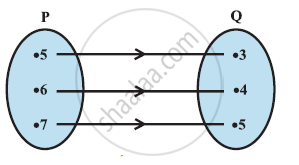
The given figure shows a relationship between the sets P and Q. Write this relation
- in set-builder form.
- in roster form.
What is its domain and range?
Let A = [1, 2, 3, ......., 14]. Define a relation on a set A by
R = {(x, y) : 3x − y = 0, where x, y ∈ A}.
Depict this relationship using an arrow diagram. Write down its domain, co-domain and range.
Let R be a relation on N × N defined by
(a, b) R (c, d) ⇔ a + d = b + c for all (a, b), (c, d) ∈ N × N
Show that:
(i) (a, b) R (a, b) for all (a, b) ∈ N × N
Let R be a relation on N × N defined by
(a, b) R (c, d) ⇔ a + d = b + c for all (a, b), (c, d) ∈ N × N
(iii) (a, b) R (c, d) and (c, d) R (e, f) ⇒ (a, b) R (e, f) for all (a, b), (c, d), (e, f) ∈ N × N
Let R = [(x, y) : x, y ∈ Z, y = 2x − 4]. If (a, -2) and (4, b2) ∈ R, then write the values of a and b.
Select the correct answer from given alternative.
Let R be a relation on the set N be defined by {(x, y)/x, y ∈ N, 2x + y = 41} Then R is ______.
Select the correct answer from given alternative
If A = {a, b, c} The total no. of distinct relations in A × A is
Answer the following:
If A = {1, 2, 3}, B = {4, 5, 6} check if the following are relations from A to B. Also write its domain and range
R1 = {(1, 4), (1, 5), (1, 6)}
Answer the following:
Find R : A → A when A = {1, 2, 3, 4} such that R = (a, b)/a − b = 10}
Answer the following:
R = {1, 2, 3} → {1, 2, 3} given by R = {(1, 1), (2, 2), (3, 3), (1, 2), (2, 3)} Check if R is transitive
Answer the following:
Check if R : Z → Z, R = {(a, b)/2 divides a – b} is equivalence relation.
Discuss the following relation for reflexivity, symmetricity and transitivity:
On the set of natural numbers the relation R defined by “xRy if x + 2y = 1”
Let X = {a, b, c, d} and R = {(a, a), (b, b), (a, c)}. Write down the minimum number of ordered pairs to be included to R to make it reflexive
Prove that the relation “friendship” is not an equivalence relation on the set of all people in Chennai
Find the domain and range of the relation R given by R = {(x, y) : y = `x + 6/x`; where x, y ∈ N and x < 6}.
Let f: R `rightarrow` R be defined by f(x) = `x/(1 + x^2), x ∈ R`. Then the range of f is ______.
Let S = {x ∈ R : x ≥ 0 and `2|sqrt(x) - 3| + sqrt(x)(sqrt(x) - 6) + 6 = 0}`. Then S ______.
Let N denote the set of all natural numbers. Define two binary relations on N as R1 = {(x, y) ∈ N × N : 2x + y = 10} and R2 = {(x, y) ∈ N × N : x + 2y = 10}. Then ______.
A function from set \(A\) to set \(B\) is a relation in which:
Which statement is true in general for ordered pairs?
