English
Karnataka Board PUCPUC Science Class 11

Observe the diagram and answer the following; (i) (ii) Are these types of guard cells found in monocots or dicots? Which of these shows a higher water content (i) or (ii)? - Biology

Advertisements
Advertisements

Question

Observe the diagram and answer the following;
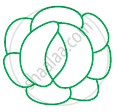

(i)

(ii)
  1. Are these types of guard cells found in monocots or dicots?
  2. Which of these shows a higher water content (i) or (ii)?
  3. Which element plays an important role in the opening and closing of stomata?
Short/Brief Note
Advertisements

Solution

  1. These types of guard cells are found in dicots because as we know the shape is bean-shaped. Whereas monocots, it is usually dumble-shaped.
  2. Higher water content is shown in figure (i).
  3. The element that plays an important role in the opening and closing of stomata is the potassium ion.
shaalaa.com
  Is there an error in this question or solution?
Chapter 11: Transport in Plants - Exercises [Page 59]

APPEARS IN

NCERT Exemplar Biology [English] Class 11
Chapter 11 Transport in Plants
Exercises | Q 24. | Page 59

RELATED QUESTIONS

An apparatus, as shown below, was set up to investigate a physiological process in plants. The setup was kept in sunlight for two hours. Droplets of water were then seen inside the bell jar. Answer the questions that follow:

  1. Name the process being studied.
  2. Explain the process named above in Q.3(a)(i).
  3. Why was the pot covered with a plastic sheet?
  4. Suggest a suitable control for this experiment.
  5. Mention two ways in which this process is beneficial to plants.
  6. List three adaptations in plants to reduce the above mentioned process.

Under what conditions do plant transpire more quickly?


State whether the following statement is true or false. Rewrite the false statement correctly.

Transpiration is the loss of water from the roots of the plant.


Fill in the blank with the suitable term given below:

Transpiration is more when the wind is blowing _____.


Fill in the blank:

Water is lost from the leaves by__________.


 Define the termTranspiration


The figure below represents the set-up at the start of certain experiment to demonstrate an activity of plants:
(i) What is the aim of the experiment?
(ii) Why has oil been put in each test tube?
(iii) What will be the observations in the two test-tubes after about 2-3 days?
(iv) Give reasons to explain any change observed as answered in (iii) above.
(v) Why has the test-tube b without the plant, been taken in the experiment?


Given alongside is the diagram of an experimental set-up to demonstrate a certain phenomenon in plants.

What is the purpose of the spring balance in the set-up?


An apparatus as shown below was set up to investigate a physiological process in plants. The setup was kept in sunlight for two hours. Droplets of water were then seen inside the bell jar. Answer the questions that follow:

Why was the pot covered with a plastic sheet?


Define the following term:

Transpiration


Define the term:

Guttation


Name the cell that surrounds the stoma.


Stomata of a plant open due to ______.


Plants lose water by the process of transpiration.


Identify the wrong statement and correct it.

Leaves perform the function of transpiration only.


Transpiration takes place through ______.


Entry of water into root hair is the demonstration of which of the following process?


Which one is not related to transpiration?


Do different species of plants growing in the same area show the same rate of transpiration at a particular time? Justify your answer.


(a) State whether the following statement are True or False.

(b) Rewrite the false statement in the correct form by changing either the first or the last word only.

Transpiration helps to cool the body of the plant.


Share
Notifications

Englishहिंदीमराठी


      Forgot password?
Use app×