Advertisements
Advertisements
Question
Column ‘II’ is a list of items related to ideas in Column ‘I’. Match the term in Column ‘II’ with a suitable idea given in Column ‘I’.
| Column I | Column II |
| (i) Diffusion | (a) The exit or flow of water from the cell to the outer environment. |
| (ii) Xylem | (b) The shrinkage of protoplasm when the cell is kept in a hypertonic solution. |
| (iii) Root pressure | (c) The tissue through which water and mineral salts move upward in a plant. |
| (iv) Isotonic solution | (d) Two solutions which have equal osmotic pressure. |
| (v) Exosmosis | (e) The process by which the molecules of perfume spread in the room when the bottle is open. |
| (vi) Osmosis | (f) The process by which roots absorb water from the soil. |
| (vii) Plasmolysis | (g) The pressure by which water rises up to some feet in a lofty tree. |
| (viii) Hypotonic solution | (h) The concentration of the solution when lower than that of the cell sap. |
Advertisements
Solution
| Column I | Column II |
| (i) Diffusion | (e) The process by which the molecules of perfume spread in the room when the bottle is open. |
| (ii) Xylem | (c) The tissue through which water and mineral salts move upward in a plant. |
| (iii) Root pressure | (g) The pressure by which water rises up to some feet in a lofty tree. |
| (iv) Isotonic solution | (d) Two solutions which have equal osmotic pressure. |
| (v) Exosmosis | (a) The exit or flow of water from the cell to the outer environment. |
| (vi) Osmosis | (f) The process by which roots absorb water from the soil. |
| (vii) Plasmolysis | (b) The shrinkage of protoplasm when the cell is kept in a hypertonic solution. |
| (viii) Hypotonic solution | (h) The concentration of the solution when lower than that of the cell sap. |
APPEARS IN
RELATED QUESTIONS
State whether the following statement is true or false. Rewrite the false statement correctly.
Water absorption mainly occurs through the root-hair.
Mention whether the following statement is true or false. Correct the false statement by altering the last word only.
Xylem is the water conducting tissue in plants.
Choose the correct answer:
In ascent of sap water reaches upwards ____________
The diagram below represents a layer of epidermal cells showing a fully grown root hair. Study the diagram and answer the questions that follow:

Draw a diagram of the above root hair cell as it would appear when a concentrated solution of fertilizers is added near it.
Study the experimental setup in the figure and then answer the question that follow.
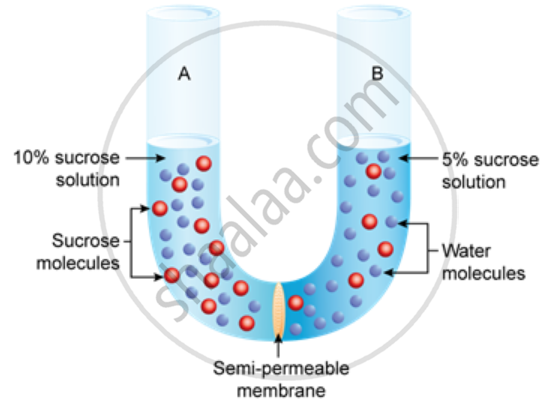
What will you observe in the setup after about half an hour? Give reasons for your answer.
________ type of tissues are present in epiphytic roots.
Plasma Membrane is ______.
Part of the root that absorbs water from the soil is ______.
Give other name of epidermal cells in roots of plants.
