Advertisements
Advertisements
Question
Name two examples in which the mechanical energy of a system remains constant.
Advertisements
Solution
(1) A body hurled vertically upward under gravity experiences a continuous increase in P.E. and a continuous decrease in KE. The sum of these two quantities at any one time stays constant.
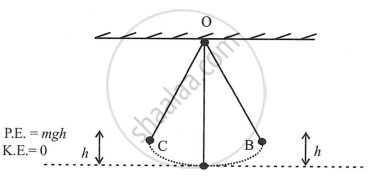
(2) Because of the height h above ground and KE = 0, in the case of a simple pendulum at B, Bob just has P.E.
∴ Sum of P.E. + K.E. = mgh + 0 = mgh
At A the resting position h = 0 and P.E. = 0 but has maximum KE. (Since P.E. has been converted into KE.)
∴ Sum of P.E. and K.E. is same at A as at B.
Now again as bob rises above ground to position C, K.E., decreases to zero and P.E. = mgh
∴ Sum of P.E. and K.E. = mgh
We see that in all three places, P.E. + K.E., i.e., the mechanical energy of the system, remains constant.
APPEARS IN
RELATED QUESTIONS
Name the type of energy (kinetic or potential) possessed by the following:
A stretched rubber band.
Name six different forms of energy?
Select the renewable and non-renewable sources of energy from the following:
Diesel
What is a solar cell?
State two advantages of using wind energy for generating electricity.
How much hydroelectric power is generated in India?
Show that the quantity 2K/v2 has the unit of mass, where K is the kinetic energy of the body.
Explain the principle of working of the windmill for generating electricity.
What is the form of that graph between
(i) K.E. and velocity for a constant mass?
(ii) K.E. and mass for a constant velocity?
What is meant by energy?
