Advertisements
Advertisements
प्रश्न
Name two examples in which the mechanical energy of a system remains constant.
Advertisements
उत्तर
(1) A body hurled vertically upward under gravity experiences a continuous increase in P.E. and a continuous decrease in KE. The sum of these two quantities at any one time stays constant.
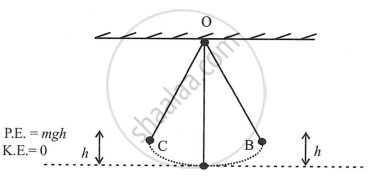
(2) Because of the height h above ground and KE = 0, in the case of a simple pendulum at B, Bob just has P.E.
∴ Sum of P.E. + K.E. = mgh + 0 = mgh
At A the resting position h = 0 and P.E. = 0 but has maximum KE. (Since P.E. has been converted into KE.)
∴ Sum of P.E. and K.E. is same at A as at B.
Now again as bob rises above ground to position C, K.E., decreases to zero and P.E. = mgh
∴ Sum of P.E. and K.E. = mgh
We see that in all three places, P.E. + K.E., i.e., the mechanical energy of the system, remains constant.
APPEARS IN
संबंधित प्रश्न
State two factors on which the kinetic energy of a moving body depends.
Name the type of energy (kinetic or potential) possessed by the following:
A stone at rest on the top of a building.
Give one example to show that the sum of potential energy and kinetic energy remains constant if friction is ignored.
Name six different forms of energy?
A body of mass 5 kg falls from a height of 10 m to 4 m. Calculate:
The total energy possessed by the body at any instant? (Take g = 10 ms-2).
A ball of mass 0.5 kg slows down from a speed of 5m/s-1 to that of 3m/s-1. Calculate the change in kinetic energy of the ball.
What kind of energy is possessed in a situation when?
A stone, in a stretched catapult.
What happens to the K.E. when
(i) the mass of the body is doubled at a constant velocity and
(ii) the velocity of the body is doubled at constant mass?
Write the type of energy possessed in the following case:
A bent bow
Give two examples each of renewable and non-renewable sources of energy?
