Advertisements
Advertisements
प्रश्न
Name two examples in which the mechanical energy of a system remains constant.
Advertisements
उत्तर
(1) A body hurled vertically upward under gravity experiences a continuous increase in P.E. and a continuous decrease in KE. The sum of these two quantities at any one time stays constant.
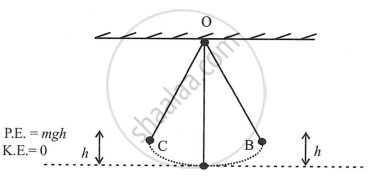
(2) Because of the height h above ground and KE = 0, in the case of a simple pendulum at B, Bob just has P.E.
∴ Sum of P.E. + K.E. = mgh + 0 = mgh
At A the resting position h = 0 and P.E. = 0 but has maximum KE. (Since P.E. has been converted into KE.)
∴ Sum of P.E. and K.E. is same at A as at B.
Now again as bob rises above ground to position C, K.E., decreases to zero and P.E. = mgh
∴ Sum of P.E. and K.E. = mgh
We see that in all three places, P.E. + K.E., i.e., the mechanical energy of the system, remains constant.
APPEARS IN
संबंधित प्रश्न
A bucket full of water .is on the first floor of your house and another identical bucket with same quantity of water is kept on the second floor. Which of the two has greater potential energy ?
A cyclist doubles his speed. How will his kinetic energy change: increase, decrease or remain same ?
A ball is made to fall freely from a height. State the kind/ kinds of energy possessed by the ball when it is just in the middle .
What is geo thermal energy? Explain in brief.
State two disadvantages of producing electricity from solar energy.
What kind of energy is possessed in a situation when?
A stone lying on the top of roof.
How much hydro-electric power is generated in India?
State the energy changes which take place when:
A body released from rest from the top of a building.
State the energy transformation on the following:
Electricity is obtained from wind energy.
Give one example when:
Electrical energy to heat energy.
