Advertisements
Advertisements
Question
Name three groups of plants that bear archegonia. Briefly describe the life cycle of any one of them.
Advertisements
Solution 1
The three groups of plants that bear archegonia are bryophytes, pteridophytes and gymnosperms.
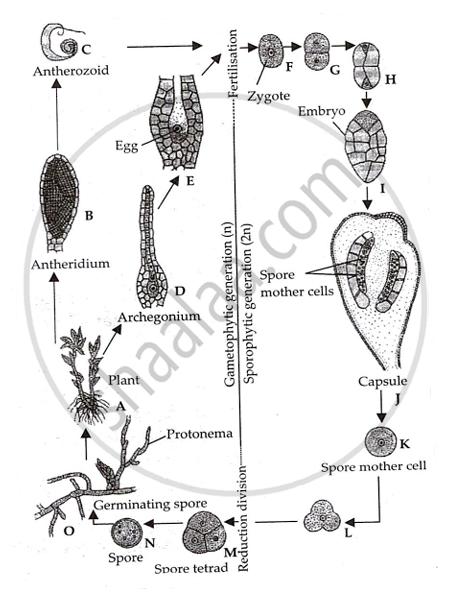
Life cycle of a bryophyte is as follows : The main plant body of bryophyte is gametophytic (n), which is independent and may be thallose (no differentiation in root, stem, leaves), e.g., Riccia, or may be foliose (having leafy axis), e.g., Funaria. The dominant phase in the life cycle of Funaria is the gametophyte, which occurs in two stages, the protonema stage and the erect, leafy gametophytic plant.
The leafy gametophyte consists of an upright, slender axis (stem-like) that bears spirally arranged leaves and is attached to the substratum by multicellular, branched rhizoids. Vegetative reproduction takes place
by fragmentation; by the buds formed in secondary protonema, etc. The sex organs, antheridia and archegonia are produced in dusters at the apices of the leafy shoots. Antheridia produces antherozoids and archegonia produces egg. Antherozoid (male gamete) and egg (female gamete) fuse and form zygote. Zygote develops into a sporophyte; which is differentiated into foot, seta and capsule, and spores are produced in the capsule.
Spores, on reaching a suitable substratum, germinate to produce a filamentous juvenile stage. called the primary protonema, which later produces secondary protonema that forms erect leafy plants
Solution 2
Archegonium is the female sexual organ that produces the female gamete or egg. It is present in the life cycles of bryophytes, pteridophytes, and gymnosperms.
Life cycle of a fern (Dryopteris)
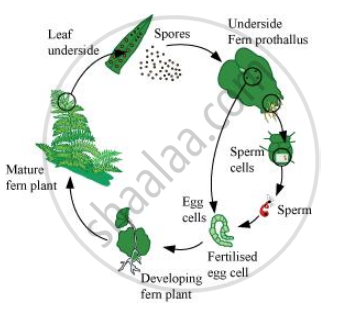
Dryopteris is a common fern with pinnately-compound leaves. The main plant's body is sporophytic. Many sporangia are borne on the lower surfaces of its mature leaves. Each sporangium has spore mother cells, which undergo meiosis to produce haploid spores. On maturing, these spores dehisce and germinate to give rise to a heart-shaped gametophyte called prothallus.
The prothallus bears the male and female sex organs called antheridia and archegonia, respectively. The antheridia produce sperms that swim in water to reach the archegonia. The egg is produced by the archegonia. As a result of fertilisation, a zygote is formed. The zygote forms an embryo, which in turn develops into a new sporophyte. The young plant comes out of the archegonium of the parent gametophyte
APPEARS IN
RELATED QUESTIONS
Mention the ploidy of the following:
Zygote of a fern
Explain briefly the following term with a suitable example:
protonema
Explain briefly the following term with a suitable example:
Antheridium
Explain briefly the following term with a suitable example:
Sporophyll
Differentiate between the following:
Liverworts and Moss
Which is NOT a character of bryophytes?
Which of the following play an important role in plant succession on bare rocks or soil?
Amphibians of the plant kingdom are
Gemmae are present in ______
A plant shows thallus level of organization. It shows rhizoids and is haploid. It needs water to complete its life cycle because the male gametes are motile. Identify the group to which it belongs to ______.
The plant body in higher plants is well differentiated and well developed. Roots are the organs used for the purpose of absorption. What is the equivalent of roots in the less developed lower plants?
In Bryophytes male and female sex organs are called ______ and ______.
Why are bryophytes called the amphibians of the plant kingdom?
The correct sequence of events in the life cycle of bryophytes is:
- Fusion of antherozoid with egg.
- Attachment of gametophyte to substratum.
- Reduction division to produce haploid spores.
- Formation of sporophyte.
- Release of antherozoids into water.
Choose the correct answer from the option given below:
Match List - I with List - II.
| List - I | List - II |
| A. Chlorophyll a | I. Yellow-green |
| B. Chlorophyll b | II. Yellow |
| C. Xanthophylls | III. Blue-green |
| D. Carotenoids | IV. Yellow to Yellow-orange |
Choose the option with all correct matches.
