Advertisements
Advertisements
Question
Advertisements
Solution
APPEARS IN
RELATED QUESTIONS
Name the spherical mirror which (i) diverges (ii) converges the beam of light incident on it. Justify your answer by drawing a ray diagram in each case.
State the two convenient rays that are chosen to construct the image by a spherical mirror for a given object? Explain your answer with the help of suitable ray diagrams.
What is meant by magnification? Write its expression. What is its sign for the (a) real (b) virtual, image?
Answer the following question.
Write the modification in the curvature of the eye lens which enables us to see the nearby objects clearly?
Select the correct option:
A mirror forms a virtual image (diminished) of an object, whatever be the position of object:
Select the correct option:
Which mirror is used in periscope?
Define the following term:
concave mirror
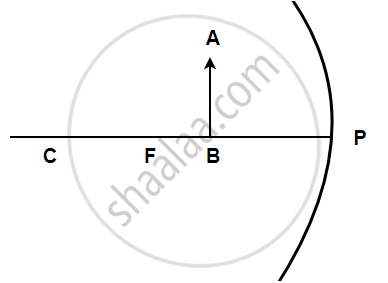
In the following figure shows a concave mirror with its pole (P), focus (F) and centre of curvature (C). Draw a ray diagram to show the formation of the image of an object AB by the concave mirror.
Define the term Principle focus.
Size of image of an object by a mirror having a focal length of 20 cm is observed to be reduced to 1/3rd of its size. At what distance the object has been placed from the mirror? What is the nature of the image and the mirror?
