Advertisements
Advertisements
Question
Name the following.
A form of energy required for a chemical change.
Advertisements
Solution
Generally, HEAT ENERGY is required but light, pressure, or electricity can also be needed.
APPEARS IN
RELATED QUESTIONS
Classify the following as chemical or physical change:
Boiling of water to form steam.
Write short answer.
Sublimation is classified as a physical change. Why ?
A burning candle shows both physical and chemical changes. Explain ?
Name a chemical change which takes place in presence of:
Write true or false
Melting of ice is a physical change.
True or false
Is melting of ice a reversible change?
Tick the most appropriate answer.
Physical changes are
Solve this crossword by using the clues that follow-
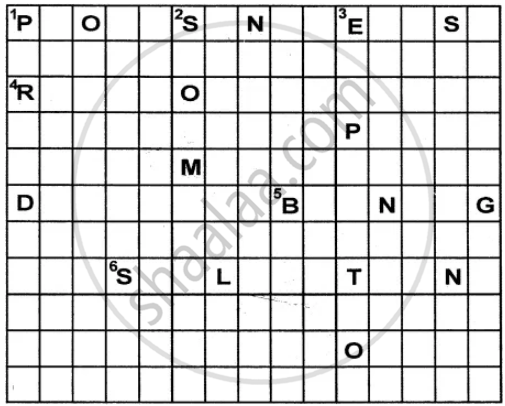
Across
1. Energy in the form of sunlight is absorbed by the green plants in this process.
4. The reddish-brown substance formed over iron in the presence of oxygen and moisture.
5. This change is permanent and irreversible.
6. The process in which a solid directly changes into gaseous state.
Down
1 . It is the change that takes place in case of swinging pendulum of a clock. –
2. Occurrence of this is a non-periodic change as well as a natural change.
3. It is a physical change.
Which of the following are physical changes and which are chemical changes?
Burning of candle wax, Melting of candle wax, Mixing of iron filings and sand, Burning of wood, Breaking a piece of chalk, Burning a piece of paper, Cutting a piece of paper.
You are given some candle wax. Can you make a candle doll from it? What kind of change is this?
