Advertisements
Advertisements
Question
Name different types of vegetation found in India and describe the vegetation of high altitudes.
Advertisements
Solution
The different types of vegetation found in India are:
(i) Tropical Evergreen Forests
(ii) Tropical Deciduous Forests
(iii) Tropical Thorn Forests and Scrubs
(iv) Montane Forests
(v) Mangrove Forests
A description of the vegetation of high altitudes :
In mountainous regions, there is a succession of natural vegetation belts in the same order as we see from the tropical to the tundra regions.
(a) The wet temperate types of forests are found between a height of 1,000 and 2,000 metres. Evergreen broad-leaf trees such as oaks and chestnuts are predominant in this area.
(b) Between 1,500 and 3,000 metres, temperate forests containing coniferous trees like pine, deodar and spruce are found. These forests cover mostly the southern slopes of the Himalayas and places having high altitude in southern and north-east India.
(c) At higher elevations, temperate grasslands are common.
(d) At altitudes higher than 3,600 metres, temperate forests and grasslands give way to the alpine vegetation. Silver fir, pines and birches are the common trees of these forests. They get progressively stunted as they approach the snow-line.
(e) Ultimately through shrubs and scrubs, they merge into the alpine grasslands.
(f) At higher altitudes, mosses and lichens form part of tundra vegetation.
RELATED QUESTIONS
Answer the following question briefly.
Define an ecosystem.
Why are Evergreen forests composed of thick vegetation and dense foliage?
Name two important factors responsible for the various vegetation belts in India.
Write answer in one sentence-
Which type of forest is found in swampy regions of India?
Find ten occupations getting raw material from forests and wildlife.
Write a poem or paragraph showing the importance of wildlife.
Give geographical reason.
Deciduous forests are found in most parts of India.
Answer the following questions on the basis of a given map.
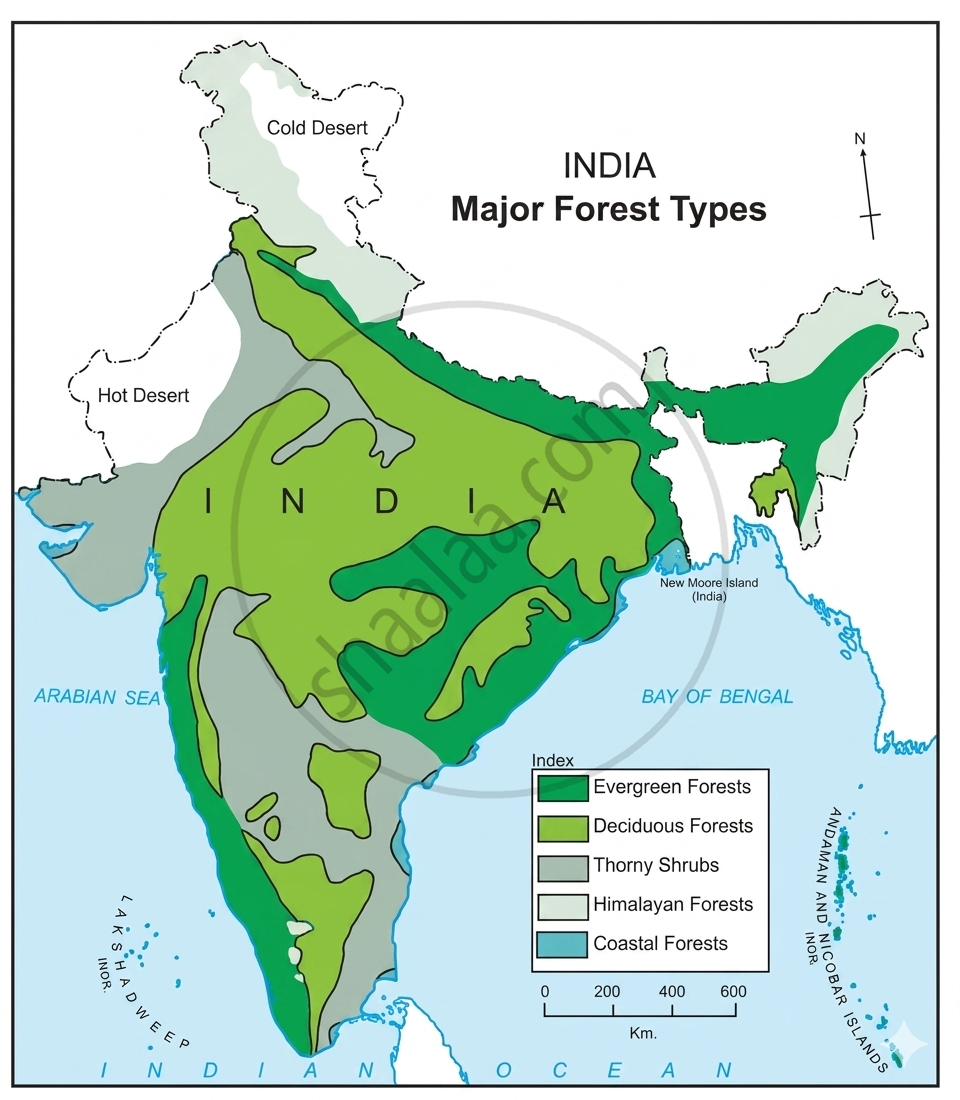
- Which forests are found in western snow-capped regions?
- On which coast do you mainly find the coastal vegetation?
- Which type of forests occupy maximum area in India ? Why?
- Where do you find thorny and shrub vegetation and why?
Match the columns:
| (a) Evergreen Forests | (i) Sundar trees |
| (b) Deciduous Forests | (ii) Pine |
| (c) Coastal Forests | (iii) Pau Brasil |
| (d) Himalayan Forests | (iv) Khejadi |
| (e) Thorny and bush-type vegetation | (v) Teak |
| (vi) Orchid | |
| (vii) Sal |
Mahesh went for an excursion with his friend and came across a marshy area with trees that had stilt like roots.
Name an area in India where this kind of vegetation is found.
