Advertisements
Advertisements
Question
Find ten occupations getting raw material from forests and wildlife.
Advertisements
Solution
Animal Husbandry, Fisheries, Carpentry, Wool Industry, Paper Industry, Leather Industry, Rubber Industry, etc.
RELATED QUESTIONS
Why has India a rich heritage of flora and fauna?
Correlate wildlife and natural vegetation in India and Brazil.
Give geographical reasons.
Vegetation is scarce in the high altitudes of Himalayas.
Write the names of the typical trees of the Evergreen Forests.
Give one use of each of the following trees: mahogany, rosewood, ebony, cinchona, bamboo.
Mountain vegetation consists not of a single type but of several types. Give reasons.
Mention two reasons why Tropical Evergreen Forests are difficult to exploit for commercial purposes.
Answer the following questions on the basis of a given map.
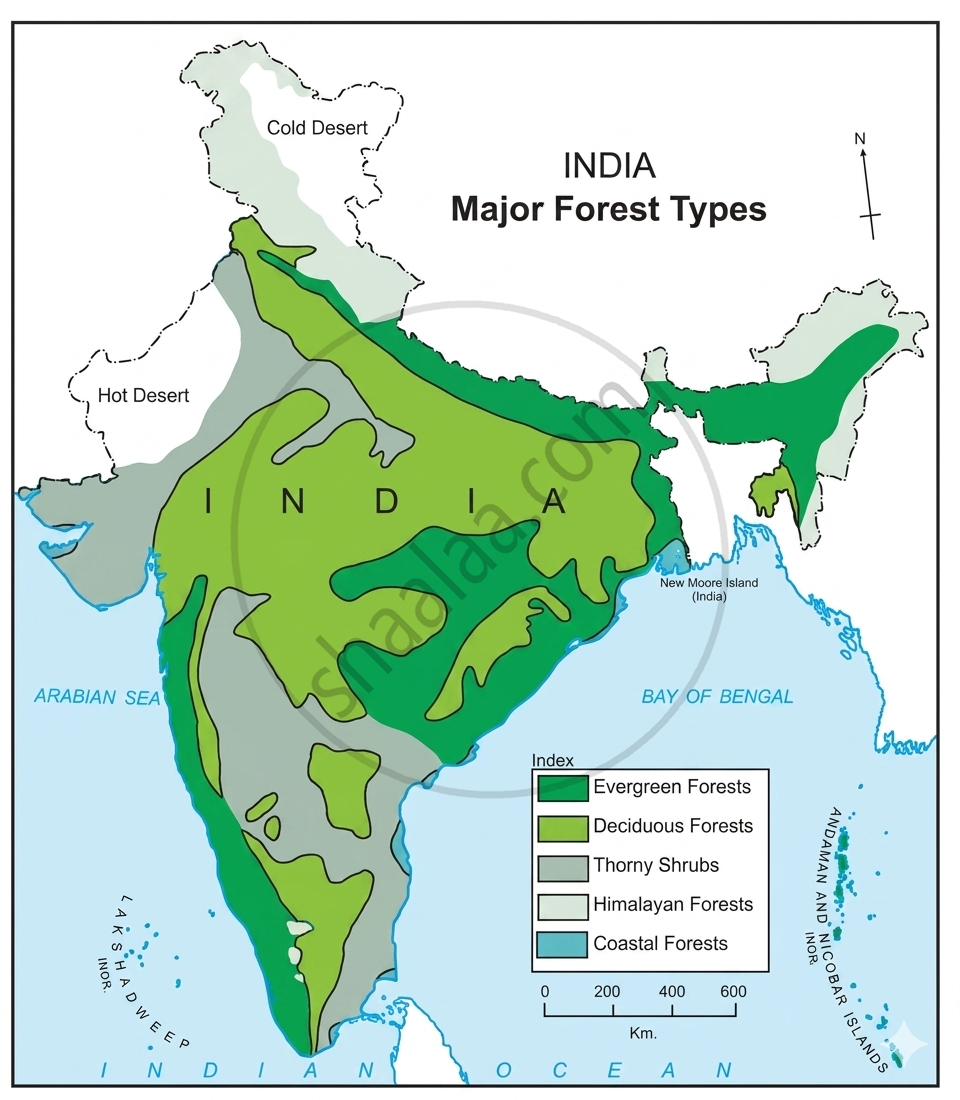
- Which forests are found in western snow-capped regions?
- On which coast do you mainly find the coastal vegetation?
- Which type of forests occupy maximum area in India ? Why?
- Where do you find thorny and shrub vegetation and why?
Identify the odd man out.
With reference to flora of India -
Identify the odd man out.
With reference to flora of India-
