Advertisements
Advertisements
Question
Name any four important functions of epithelial tissue and provide at least one example of a tissue that exemplifies each function.
Advertisements
Solution
1. Secretion: Cuboidal epithelium in kidney tubules, ducts.
2. Absorption: Columnar epithelium found in the digestive tract.
3. Filtration: Squamous epithelium found in the glomerulus of the kidney.
4. Ciliated epithelium: Found in the bronchi, uterine tubes propels the materials due to ciliary actions.
RELATED QUESTIONS
Describe various types of epithelial tissues with the help of labelled diagrams
Distinguish between Simple epithelium and compound epithelium
Based on the following information, identify the three types of epithelial tissue in the figures given below :
| a | 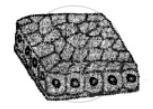 |
b | 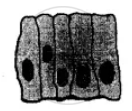 |
c | 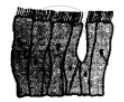 |
(1) Cuboidal epithelium: It consists of a single layer of cuboidal cells.
(2) Columnar epithelium: It is composed of tall, cylindrical cells with oval nuclei usually placed at the base of the cells.
(3) Ciliated epithelium: It consists of cells being hair-like cilia on their free surface.
Fill in the blank
Epithelial tissue is made of cells without any ...................... spaces.
Give structure, types and functions in brief of the following:
Epithelial tissue
Name the tissues found:
in the testes and ovaries.
Answer the following question.
What is cell junction?
Lining of small intestine is made up of ______.
State whether true or false. If false, correct the statement.
Epithelial tissue is protective tissue in animal body.
The ciliated epithelium lines the______.
Nerve cell does not contain
The dead element present in the phloem is
Differentiate between sclerenchyma and parenchyma tissues. Draw well labelled diagram.
Give reasons for
Meristematic cells have a prominent nucleus and dense cytoplasm but they lack vacuole.
In a certain type of cell division, the diploid number of chromosomes is reduced to half. This kind of division occurs in ______.
Glandular epithelium gives a stratified appearance.
Assertion: Materials are exchanged between epithelial and connective tissues by diffusion.
Reason: Blood vessels are absent in epithelial tissue.
Write one point of difference between
Simple and compound epithelial tissue.
Which one of the following types of cell is involved in making of the inner walls of blood vessels?
Match List I with List II.
| List I | List II |
| A. Mast cells | I. Ciliated epithelium |
| B. Inner surface of bronchiole | II. Areolar connective tissue |
| C. Blood | III. Cuboidal epithelium |
| D. Tubular parts of nephron | IV. specialised connective tissue |
Choose the correct answer from the options give below:
