Advertisements
Advertisements
Question
Distinguish between Simple epithelium and compound epithelium
Advertisements
Solution
| Simple epithelium | Compound epithelium | |
| 1 | It is composed of only one layer of cells. | It is composed of many layers of cells. |
| 2 | It is mainly involved in the function of absorption and secretion | It is mainly involved in the function of protection and has a limited role in absorption and secretion. |
| 3 | It is present in the lining of the stomach, intestine. | It is present in the lining of the pharynx and buccal cavity. |
RELATED QUESTIONS
What is the following and where do you find them in animal body?
Ciliated epithelium
Based on the following information, identify the three types of epithelial tissue in the figures given below :
| a | 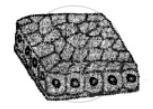 |
b | 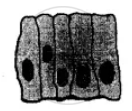 |
c | 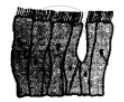 |
(1) Cuboidal epithelium: It consists of a single layer of cuboidal cells.
(2) Columnar epithelium: It is composed of tall, cylindrical cells with oval nuclei usually placed at the base of the cells.
(3) Ciliated epithelium: It consists of cells being hair-like cilia on their free surface.
Fill in the blank
Epithelial tissue is made of cells without any ...................... spaces.
Name one place in living organisms where the following tissues is located:
Squamous epithelium
Name the kind of cells found in the following place:
Inner lining of the wind pipe
Name any one body part where ciliated epithelium is found in humans. What is its function?
Name the tissues found
at the outer layer of skin.
Name the tissues found:
at the inner lining of the trachea.
Answer the following question.
What is cell junction?
Answer the following question.
Describe different types of cell junctions.
Lining of small intestine is made up of ______.
The main function of the cuboidal epithelium is
Which is not a function of epidermis?
If a potted plant is covered with a glass jar, water vapours appear on the wall of glass jar. Explain why?
In a certain type of cell division, the diploid number of chromosomes is reduced to half. This kind of division occurs in ______.
Identify the following relationship
Cuboidal: Epithelial
Cardiac: ______
Granulocytes: ______
Osteocytes: ______
Which type of tissue CORRECTLY matches with its location?
Write the appropriate type of tissues in column B according to the functions mentioned in column A.
| Column A | Column B |
| a. Secretion and absorption | i. ______ |
| b. Protective covering | ii. ______ |
| c. Linking and supporting framework | iii. ______ |
Match List I with List II.
| List I | List II |
| A. Mast cells | I. Ciliated epithelium |
| B. Inner surface of bronchiole | II. Areolar connective tissue |
| C. Blood | III. Cuboidal epithelium |
| D. Tubular parts of nephron | IV. specialised connective tissue |
Choose the correct answer from the options give below:
