Advertisements
Advertisements
Question
Match the following
| i. | Clinical thermometer | A form of energy |
| ii. | Normal temperature of human body | 100°C |
| iii. | Heat | 37°C |
| iv. | Boiling point of water | 0°C |
| v. | Melting point of water | Kink |
Advertisements
Solution
| i. | Clinical thermometer | Kink |
| ii. | Normal temperature of human body | 37°C |
| iii. | Heat | A form of energy |
| iv. | Boiling point of water | 100°C |
| v. | Melting point of water | 0°C |
APPEARS IN
RELATED QUESTIONS
The thermometer which ranger from -10°C to 110°C is ______.
All clinical thermometers have a ______ that prevents mercury from flowing back into the bulb.
Before use, the mercury level in clinical thermometer should be below ______.
Digital thermometers are mainly used to take body temperature.
Match the following :
| 1. | Mercury | a. | Maximum minimum thermometer |
| 2. | Weather report | b. | -173.15 degree C |
| 3. | 32degree F | c. | Opaque and shining |
| 4. | 100 K | d. | 0 degree C |
Explain the construction and working of the clinical thermometer.
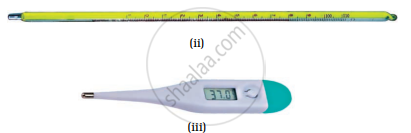
Boojho has three thermometers as shown in the following figure. He wants to measure the temperature of his body and that of boiling water. Which thermometer (s) should he choose?

Four arrangements to measure temperature of ice in beaker with laboratory thermometer are shown in the following figure (a, b, c and d). Which one of them shows the correct arrangement for accurate measurement of temperature?
Figure (a–d) shows a student reading a doctor’s thermometer. Which of the figure indicates the correct method of reading temperature?
You may have noticed that a few sharp jerks are given to a clinical thermometer before using it. Why is it done so?
