Advertisements
Advertisements
प्रश्न
Match the following
| i. | Clinical thermometer | A form of energy |
| ii. | Normal temperature of human body | 100°C |
| iii. | Heat | 37°C |
| iv. | Boiling point of water | 0°C |
| v. | Melting point of water | Kink |
Advertisements
उत्तर
| i. | Clinical thermometer | Kink |
| ii. | Normal temperature of human body | 37°C |
| iii. | Heat | A form of energy |
| iv. | Boiling point of water | 100°C |
| v. | Melting point of water | 0°C |
APPEARS IN
संबंधित प्रश्न
Describe a clinical thermometer. How does it differ from the thermometer used in laboratory?
In thermometer when bulb comes in contact with hot object, liquid inside it ______.
Mercury is often used in laboratory thermometers because it ______.
Digital thermometers do not use ______.
All clinical thermometers have a ______ that prevents mercury from flowing back into the bulb.
Mercury is a poor conductor of heat.
What is the boiling point of mercury?
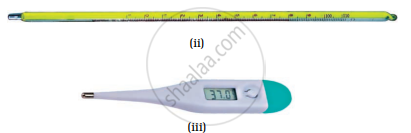
Boojho has three thermometers as shown in the following figure. He wants to measure the temperature of his body and that of boiling water. Which thermometer (s) should he choose?

A laboratory thermometer A is kept 7 cm away on the side of the flame while a similar thermometer B is kept 7 cm above the flame of a candle as shown in the following figure.
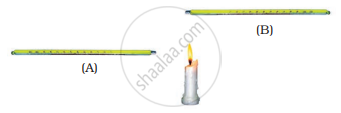
Which of the thermometers, A or B, will show a greater rise in temperature? Give reason for your answer.
In a mercury thermometer, the level of mercury rises when its bulb comes in contact with a hot object. What is the reason for this rise in the level of mercury?
