Advertisements
Advertisements
प्रश्न
Describe a clinical thermometer. How does it differ from the thermometer used in laboratory?
Advertisements
उत्तर
A clinical thermometer has a narrow stem and a long bulb filled with mercury (or alcohol). There is a small constriction in the stem above the bulb. When the bulb of the thermometer is held in the armpit or the mouth of a patient, the mercury (or alcohol) in the bulb rises in the stem.
When it is taken out of the patient’s body, the small constriction does not allow the mercury (or alcohol) from the stem to retreat into the bulb. Thus, this arrangement enables us to read the temperature of the patient’s body at ease after the removal of the thermometer from his body
The figure shows a clinical thermometer. It has a slight bend or kink in the stem just above the bulb, this kink is called the constriction which prevents the mercury from falling back all by itself. As the body temperature of a healthy person is 37°C, clinical thermometers are designed to measure temperatures between 35°C and 42°C.

Clinical thermometer
संबंधित प्रश्न
A thermometer is used to measure ______.
What is the use of kink in clinical thermometer?
Why do we jerk a clinical thermometer before we measure the body temperature?
A clinical thermometer is calibrated from to ______.
The thermometer which ranger from -10°C to 110°C is ______.
A clinical thermometer indicates temperatures from a minimum of ______ °F to a ______ maximum of °F.
Why mercury or alcohol is used in thermometers?
We are advised to avoid keeping the clinical thermometer in the sun or near a flame. Why?
Four arrangements to measure temperature of ice in beaker with laboratory thermometer are shown in the following figure (a, b, c and d). Which one of them shows the correct arrangement for accurate measurement of temperature?
A laboratory thermometer A is kept 7 cm away on the side of the flame while a similar thermometer B is kept 7 cm above the flame of a candle as shown in the following figure.
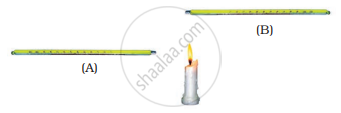
Which of the thermometers, A or B, will show a greater rise in temperature? Give reason for your answer.
