Advertisements
Advertisements
Question
Match the following:
| Figure | Name | ||
| (a) |  |
(a) | Hexahedron |
| (b) |  |
(b) | Hexagonal Prism |
| (c) |  |
(c) | Square Pyramid |
| (d) |  |
(d) | Cone |
Advertisements
Solution
| Figure | Name | ||
| (a) |  |
(b) | Hexagonal Prism |
| (b) |  |
(d) | Cone |
| (c) |  |
(c) | Square Pyramid |
| (d) |  |
(a) | Hexahedron |
Explanation:
In figure (a), the base and top both are the hexagonal polygons. So, it is a hexagonal prism.
In figure (b), only one vertexes available. So, it is a cone.
In figure (c), the base is square and rest four faces are equilateral triangles. So, it is a square pyramid.
In figure (d), the base is square and it has 6 faces and 8 vertices. So, it is a hexahedron (cube). [Note Cube is also known as Hexahedron.]
APPEARS IN
RELATED QUESTIONS
Which 3-D shapes do the following nets represent? Draw them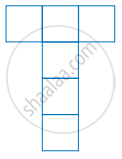
Which 3-D shapes do the following nets represent? Draw them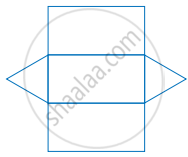
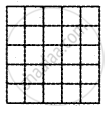
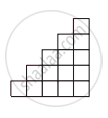
Here are some drawings of the model. Mark the correct top view drawing with 'T' and the correct side view drawing with 'S'.
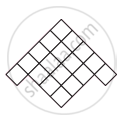
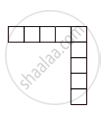
The given net  can be folded to make a ______.
Every cylinder has 2 opposite faces as congruent circles, so it is also a prism.
The given shape is a cylinder.

How many edges does the following solid have?
Cone
The base of a triangular pyramid is a ______.
Out of ______ faces of a square pyramid, ______ are triangles and ______ is/are squares.
Draw a net of a cuboid having same breadth and height, but length double the breadth.
