Advertisements
Advertisements
प्रश्न
Match the following:
| Figure | Name | ||
| (a) |  |
(a) | Hexahedron |
| (b) |  |
(b) | Hexagonal Prism |
| (c) |  |
(c) | Square Pyramid |
| (d) |  |
(d) | Cone |
Advertisements
उत्तर
| Figure | Name | ||
| (a) |  |
(b) | Hexagonal Prism |
| (b) |  |
(d) | Cone |
| (c) |  |
(c) | Square Pyramid |
| (d) |  |
(a) | Hexahedron |
Explanation:
In figure (a), the base and top both are the hexagonal polygons. So, it is a hexagonal prism.
In figure (b), only one vertexes available. So, it is a cone.
In figure (c), the base is square and rest four faces are equilateral triangles. So, it is a square pyramid.
In figure (d), the base is square and it has 6 faces and 8 vertices. So, it is a hexahedron (cube). [Note Cube is also known as Hexahedron.]
APPEARS IN
संबंधित प्रश्न
Solid having only line segments as its edges is a ______.
Draw the net of the following cuboid:

The name of the solid in figure is ______.
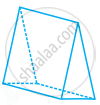
Out of ______ faces of a triangular prism, ______ are rectangles and ______ are triangles.
Cuboid is a rectangular ______.
Rectangular prism and cuboid refer to the same solid.
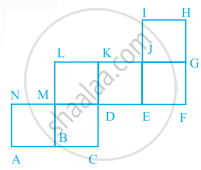
The net given below in the figure can be used to make a cube. Which edge meets AN?
Draw the net of rectangular pyramid with slant edge 6 cm and base as rectangle with length 4 cm and breadth 3 cm.
What is a net of a three-dimensional object?
How many plane squares are present in the net of a cube?
