The police interview Chetan to get an eyewitness account of the kidnapping. In pairs conduct the interview. One of you can play the role of Chetan and tell your partner, who plays the role of the police officer, what happened when the kidnapping occurred.
Advertisements
Advertisements
Question
Look at the numbers on the map, and match them with the names given in the box below.
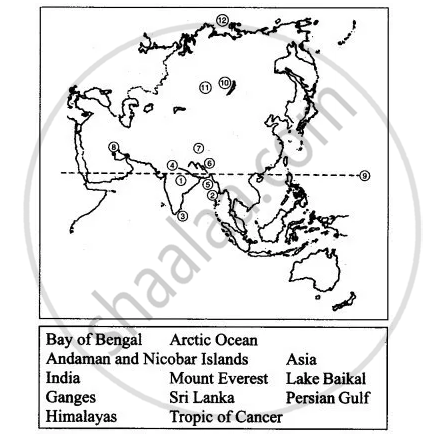
Advertisements
Solution
- _____India
- _____ Andaman and Nicobar Islands
- _____ Sri Lanka
- _____ Ganges
- _____ Bay of Bengal
- _____ Himalayas
- _____ Mount Everest
- _____ Persian Gulf
- _____ Tropic of Cancer
- _____ Lake Baikal
- _____ Asia
- _____Arctic Ocean
APPEARS IN
RELATED QUESTIONS
Now, using the ideas given below, write a speech on 'The Role of Youth in Realising the Dreams of Dr. Kalam'. (Refer to CODER)
a) fighting for equal rights
b) fighting corruption
c) empowering the masses
d) looking for jobs within the country
e) active involvement in social issues
f) promoting national integration
g) equal participation of women in all fields
Answer the following question briefly
Which of the following traits are relevant to the character of the narrator's grandmother?
(i) determined
(ii) selfish
(iii) emotional
(iv)mean
Give reasons for your choice.
Answer the following question briefly:
What did the Professor mean by “intelligent reading”?
Answer the following question:
Why was it necessary to keep Harold’s father’s profession a secret from him?
Answer the following question briefly.
Why did John get off at Coketown?
List common dilemmas that teenagers face involving the choice of one or more “roads”. Give examples of “roads” that you must travel (e.g. facing peer pressure, choosing friends, observing rules laid down by school and parents, acting on your own values).
On the basis of your reading of the poem, complete the following table.
| Stages in the life of the poet | Activities | Consequences |
| Youth | eating toffees ____________ |
____________ |
| Adulthood | ____________ | gazing at the dentist in despair. |
Answer the following question.
Why did the poet go to the dentist? How could she have avoided it?
Answer the following question briefly.
Why does Jeanne want to buy a villa?
Answer the following question briefly.
The convict says, "I am too old a bird to be caught with chaff." What does he mean
by this statement?
During summer vacation, you and your friends decide to enroll in 'The School for Flying'. While training, you had an interesting and unforgettable experience. Here's an account of it. Complete it by using words from A.1.
It was the most amazing summer camp that we had ever been to. My friend Jonathan and I decided to join the flying-school. We underwent rigorous training and gained a lot of expertise, Jonathan in charting the course of flight and I, in flying the plane. 25 May 2010 was the Red Letter Day as we were to fly a plane for nearly half an hour without an instructor. At 6: 15 GMT we took the flight, Jonathan as a (1)............ and I, as the (2) ............ . We remembered all the instructions given to us at the academy and we were (3) ............ signals at frequent intervals. The day was clear but windy. We were (4) ................. hills and were flying along the coast. Suddenly, the weather turned turbulent. We (5)............ our position asking for advice. But unfortunately there was no communication from the other end. All of a sudden, we heard an explosion. The fuel tank of our plane had caught fire due to the lightning. We immediately decided to (6) ............... the plane and donned the (7) .......... that were available. We were blown off 55-60 kms away from the coast and we landed on the outskirts of a dense forest. We were not injured but were hungry and thirsty. We ate some wild fruit hoping it was safe. But unluckily it was disastrous for Jonathan as he had (8) ............ after that. We remembered our instructor's clear and (9)................ instructions in case of an emergency. We discussed various strategies and decided to (10).............. to the core about the life saving strategies. We started exploring the forest. We must have wandered for about an hour or so along the coast, when my eyes suddenly fell on something red in the crevice of a big rock. I went closer to it and to my great happiness and relief I saw a (11) ............. . It was (12).......... away in a cosy nook. Oh! What a relief it was! We were successful in rowing our way back from where we had started. Meanwhile, the coast guards were hunting for us. We had instantly become celebrities!
Past Continuous
A young girl was kidnapped from the main street of Srutipur at 3 o’clock yesterday afternoon. Chetan was there at that time.

Complete the introduction given below to the story The Story Teller by Saki (H.H. Munro), by using ‘a’ ‘art’ or ‘the’’:
The afternoon was hot, and so was (a)______ railway carriage. (b)_______ next stop was at Templecombe, nearly (c)______ hour ahead. In the carriage were a small girl, (d)______ smaller girl, and a small boy. (e)________ aunt belonging to (f)______ children sat in (g)_________ comer seat, and in (h)_______ further comer seat on (i)______ opposite side, was a man who was a stranger to them, but (j)_____ small girls and the small boys were (k)_________ ones who filled the compartment. The children chatted on and on to their aunt, like (l)____ housefly that refuses to be put off. Most of the aunt’s remarks seemed to begin with “Don’t”, and nearly all of (m)______ children’s remarks began with “Why?”
As a resident of Kanpur, write a formal letter to the Editor of a prominent newspaper highlighting the problem discussed in Question 2. Also give some suggestions on how this problem can be reduced.
|
FORMAL LETTER A-43 Civil lines |
Based on your reading of the above story, answer the following questions:
- How did the Bedouin and his wife extend their hospitality to the weary traveller?
- Why didn’t she have any meat left to serve her guest?
- Why was her son crying out aloud?
- How did she cover up her mistake?
- Why did the traveller flee from the tent?
Write the contracted forms. Practise saying these words.
e.g. ought not to – oughtn’t to.
- cannot _______
- need not _______
- should not _______
- must not _______
- do not _______
- did not _______
: Duties and Privileges
. In some schools the student - council members are assigned duties at the
beginning of every academic year.
Write a job description to be given to the newly elected Environment
Monitor of your school.
You may do this individually. Later your class as a whole can come out with one
duty list to be displayed on the soft-board. You may use the words given in the
box below.
can, may, can’t, mustn’t, must, should, have to.
Grandmaster Koneru Humpy is visiting your school and you, as the Sports Captain, have to introduce her in the school assembly. With the help of Question 2, write out the Bio-sketch.
Below is a description of Geothermal Energy. Complete the passage by filling in the gaps choosing the correct option from the given options. The first one has been done for you.
In volcanic areas, underground water (a) can often rise to a temperature of 200° C. Nowadays, wells (b) __________ drilled to extract the steam which is used to drive turbines. This is (c) __________ of the world’s fastest growing sources of energy. (d) __________ the water is heated by enormous reservoirs of cooling rock several kilometers across, geothermal steam is (e) __________ to be a renewable energy resource. Even in non- volcanic areas, underground water can (f) __________ heated by natural radioactivity. In this case, (g) __________, it is necessary to drill deeper before the water is as hot as 200° C. This method (h) __________ used for heating homes in certain areas for many years and is cheap, clean and efficient.
| (a) (i) could (ii) can (iii) must (iv) might |
(b) (i) is (ii) been (iii) are (iv) being |
(c) (i) any (ii) some (iii) one (iv) few |
(d) (i) As (ii) While (iii) Though (iv) Even |
| (e) (i) called (ii) said (iii) regarded (iv) told |
(f) (i) be (ii) been (iii) being (iv) is |
(g) (i) however (ii) though (iii) despite (iv) therefore |
(h) (i) being (ii) was (iii) be (iv) has been |
