Advertisements
Advertisements
प्रश्न
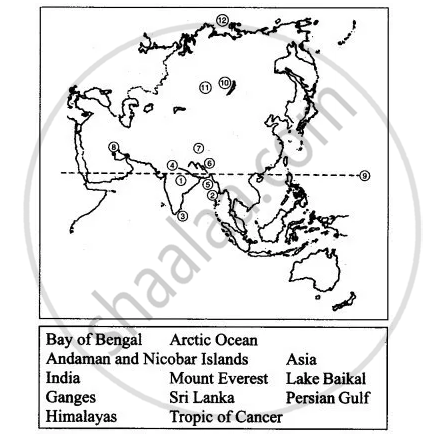
Look at the numbers on the map, and match them with the names given in the box below.
Advertisements
उत्तर
- _____India
- _____ Andaman and Nicobar Islands
- _____ Sri Lanka
- _____ Ganges
- _____ Bay of Bengal
- _____ Himalayas
- _____ Mount Everest
- _____ Persian Gulf
- _____ Tropic of Cancer
- _____ Lake Baikal
- _____ Asia
- _____Arctic Ocean
APPEARS IN
संबंधित प्रश्न
Answer the following question briefly:
What were the Professor’s ambitions in the army?
Identify the rhyme scheme of the poem.
List common dilemmas that teenagers face involving the choice of one or more “roads”. Give examples of “roads” that you must travel (e.g. facing peer pressure, choosing friends, observing rules laid down by school and parents, acting on your own values).
Answer the following question briefly.
Describe the two roads that the poet comes across.
Answer the following question briefly.
Which road would you choose? Why?
Answer the following question.
Give an appropriate proverb that conveys the message that this poem carries.
Answer the following question briefly.
Why was the convict sent to prison? What was the punishment given to him?
Identify the situations which can be termed as the turning points in the convict's
life?
Below are some incomplete sentences about the story. Complete each sentence appropriately, according to the story.
1. Slava Kurilov was in the water because he ...
Evidence for this is ...
2. His biggestmistakewaswhenhe ...
3. He decided to die because ...
4. He was carried towards the lagoon when he decided to ...
Study the given notes and complete the paragraph that follows by filling in the blanks.
Mobile phones — emit electromagneticfield — prolonged exposure — researchneeded — brain illness — cancer memoryloss — evidence — likely to cause — healthscares — press reports — people worryneedlessly.
Think about it. Every time you use a mobile phone, (a)_____________ head to electromagnetic emission. Manufacturers (b)___________to prove there is no risk (c)_____________ . Some evidence, so far suggests that mobile phone emissions (d)_________ . These health scares (e)______ . So, people worry needlessly.
(a) (i) he exposes his
(ii) one exposes his
(iii) one exposes one’s
(b) (i) needed
(ii) are needed
(iii) have needed
(iv) need
(c) (i) in brain cancer or memory loss
(ii) from brain cancer or memory loss
(iii) with brain cancer or memory loss
(iv) of brain cancer or memory loss
(d) (i) are likely to cause illness
(ii) are likely for causing illness
(iii) is likely in causing illness
(v) is likely to cause illness
(e) (i) is base on press reports
(ii) have been based on press reports
(iii) are based on press reports
(iv) are being based on press reports
Choose a suitable word from the options given and complete the story from Tunisia.
A weary traveller stopped at a Bedouin’s tent and asked for shelter for the night. Without (a)_______ delay, the man killed (b) _______chicken and handed it to (c)_______ wife for (d)___________ guest’s supper. As the woman stirred the meat in (e) _______ copper cooking pot, she smelled the rich steam and could not resist tasting (f)________ of the meat and soup, to see if it was soft and tasty. But mouthful followed mouthful, and there wasn’t (g)__________chicken left but for the neck piece, which she gave to her little son to nibble. The boy found it so tasty that he whined, “Give me (h)_______ more chicken, mother!” The woman slapped the little boy and scolded him: “It’s a shameful habit (i)______ father taught you, enough of it, I tell you!” On the (j) _______ side of the wooden hanging which screened the woman’s part of the tent from the rest, the traveller overheard them. “What habit has (k)______ father taught (l) _______ child?” he asked curiously. “Oh,” said the woman, “whenever a guest arrives at (m)_______ tent, he cuts off his ears and roasts them over the fire for (n)______ son to eat.” Making not a sound, the traveller picked up (o)_______ shoes and ran.
| (a) (i) no any (ii) little (iii) any (iv) no |
| (b) (i) a few (ii) some (iii) few (iv) a |
| (c) (i) his (ii) her (iii) their (iv) there |
| (d) (i) the (ii) a (iii) theirs (iv) their |
| (e) (i) her (ii) hers (iii) the (iv) an |
| (f) (i) some (ii) few (iii) a few (iv) more |
| (g) (i) any (ii) some (iii) a few (iv) few |
| (h) (i) little (ii) a little (iii) a few (iv) some |
| (i) (i) hers (ii) yours (iii) their (iv) his |
| (j) (i) another (ii) another (iii) other (iv) one |
| (k) (i) hers (ii) her (iii) him (iv) his |
| (l) (i) a (ii) an (iii) the (iv) x |
| (m) (i) x (ii) our (iii) ours (iv) their |
| (n) (i) their (ii) his (iii) him (iv) our |
| (o) (i) her (ii) his (iii) our (iv) x |
Read the following excerpts from newspapers on various environmental issues.
Ban the Bag
The Indus Valley Civilisation left beautifullycrafted pottery that speaks volumes of the advances its people made. After 3,000 years, if the ruins we leave behind are excavated, chances are only plastic bags would be dug up. It may sound like an exaggeration, but these bags are not biodegradable. Apart from causing emissions when these are manufactured, noxious fumes are released while these are being burnt or disposed off. So, be kind to Mother Earth the next time you go shopping for groceries, remember to carry a cloth bag with you.

What India Should Do
India has released the National Action Plan on Climate Change. Is it adequate? Is there more that the country can do? Here are some ways how we can make a difference.
(a) SOLAR MISSION
1) To promote the use of solar energy through solar photovoltaic and thermal systems for power generation .
2) To integrate other renewable energy technologies like biomass and wind. 
(b) ENERGY EFFICIENCY
1) To mitigate GHG through sector-specific and cross-cutting technology and fuel switch options.
2) To use more LNG and biomass fuels besides seeking tech transfer. 
(c) SUSTAINABLE HABITAT
1) To promote energy efficiency in the residential and commercial sectors through LPG use.
2) To manage municipal solid waste and urban public transport in a better way. 
(d) WATER MISSION
1) To promote efficient water use, augment supply in critical areas and ensure effective management of water resources.
2) To have better management of surface and groundwater,and conserve wetlands. 
(e) SUSTAINING HIMALAYAS
1) To enhance monitoring and conservation of the Himalayan ecosystems, empower local communities for management of ecological resources and promote sustainable tourism. 
(f) GREEN INDIA
1) To reduce fragmentation of forests, enhance public and private investments for plantation, upscale joint forestry management and promote conservation of biodiversity. Need to afforest degraded lands.

(g) SUSTAINABLE AGRICULTURE :
1) To focus on four crucial areas - dry land agriculture, risk management, access to information and promoting the use of biotechnology.
2) To develop drought and pest resistant varieties. 
Answer the following question by ticking the correct option :
What did the man do to prove his point?
In each sentence four words are underlined. One of them is incorrect. Pick out the incorrect words and write them in the answer space against the correct number:
- Music therapy use music to improve the patient’s health.
_______________________________ - It is used with individuals of all ages.
_______________________________ - It helps in curing a variety of medical problems as substance abuse and aging.
_______________________________ - It is also used to improve learning and reduces stress,
_______________________________
The table below provides you with a list of modals that are used to express necessity and permission.
| Necessity I obligation | Permission |
|
Positive must obeying have to authority need to ought to right thing should to do |
Positive can (less formal) may (more formal)
|
|
Negative must not cannot ought not to |
Negative need not do not have to
|
The Environment in Danger
What do you think will happen to the following?
Choose four, and write one sentence about each using the modals below and/ or expressions from 10.
(a) The ozone layer
(b) The Taj Mahal
(c) The Maldives
(d) The rainforests
(e) Weather patterns
(f) Fossil fuels
(g) The Ganges delta
e.g. In my opinion, the hole in the ozone layer will grow bigger and more people will get skin cancer.
Given below is a list or other expressions. Decide what each expression means, by writing D for 'difference' or S for 'similarity' against each. Try to add more expressions to your list and make use of them in writing your article in Question 6.
| Expressions | D or s |
| X is different from Y in that _______ | |
| X and Y are alike in that ______ | |
| X and Y have _____ in common. | |
| Whereas X _________ , Y _____________ | |
| Compared to X, Y ________ | |
| X ____ In contrast, Y ____ | |
| X _____ However, Y _____ | |
| X and Y both |
You are on the editorial board for the column ‘Your Problems’ in The Teenager magazine. You have received these two letters asking for your advice. (They appear to have come from the same family)
|
Dear Helpful Avanti My fifteen year old son is crazy about film music. He seems to be wasting all his pocla:t money on these meaningless CDs. He cannot even study without this noise. Though he is good at studies, I remain disturbed about this new obsession. There are all kinds of strange-looking posters on the walls of his study and he always wears those gaudy T-shirts and faded patched jeans. Also, he is very fond of Junk-food. I fear he is breaking all links with our culture. |
|
Dear Helpful Avanti I love film music and I have bought a lot of CDs from my pocket-money allowance. But whenever I switch on my CD-player, my father frowns and orders me to switch off the 'jarring noise'. He calls it 'cheap' and 'uncivilised' stuff. It is not that I do not like classical music, but when I am with my friends, we listen to film music. I like Indian clothes and food. But, I also like to wear western clothes and eat continental food occasionally. I do not like to disobey my parents, but I do not want to give up my music and other interests. |
In pairs, decide what advice to give to each of them. Then write one letter each, so that both father and son get a reply from The Teenager. Remember to use some of the language in Question 5.
When both students have completed their half of the table above, exchange information, by asking and answering questions e.g.
1. What's the weight of the football?
2. When do you get a penalty in hockey?
As you receive information from your partner, write it down in the other half of the table above. (Do not let your partner look at your table!)
Adjectives and Prepositions
Look at the table below. Decide which of the adjectives in Column A commonly go with which preposition. Tick the table as shown. (There may be more then one tick for each adjective).
| A | at | to | about | for |
| worried | ![]() |
![]() |
||
| good | ||||
| bad | ||||
| surprised | ||||
| happy | ||||
| sensitive | ||||
| puzzled | ||||
| married | ||||
| clever | ||||
| suitable | ||||
| curious | ||||
| due | ||||
| qualified | ||||
| famous |


