Advertisements
Advertisements
Question
Look at figure which shows solutions taken in test tubes A, B, C and D. What colour is expected when a piece of red litmus paper is dropped in each test tube? Nature of the solutions is given in the table for your help.
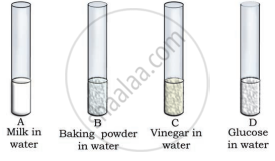
| Test tube | Nature of Solution | Change in colour of red litmus |
| A | Neutral | |
| B | Basic | |
| C | Acidic | |
| D | Neutral |
Complete the Table
Advertisements
Solution
| Test tube | Nature of Solution | Change in colour of red litmus |
| A (Milk) | Neutral | No change |
| B (Baking powder) | Basic | Turn blue |
| C (Vinegar) | Acidic | No change |
| D (Glucose) | Neutral | No change |
shaalaa.com
Is there an error in this question or solution?
APPEARS IN
RELATED QUESTIONS
What do you understand by an alkali?
Give one example in the following case:
A base which does not contain a metal ion.
Why indicator does not get affected by salt?
Main constituent of base is ______.
Chemical formula of calcium oxide is _______
All bases are alkalis.
When the soil is too basic, plants do not grow well in it. To improve its quality what must be added to the soil?
Match the following:
| 1. | Sulphuric acid | a. | Weak base |
| 2. | Sodium hydroxide | b. | Strong acid |
| 3. | Acetic acid | c. | Strong base |
| 4. | Ammonium hydroxide | d. | Weak acid |
Which of the following pairs are weak bases?
NaOH & KOH are strong bases.
