Advertisements
Advertisements
प्रश्न
Look at figure which shows solutions taken in test tubes A, B, C and D. What colour is expected when a piece of red litmus paper is dropped in each test tube? Nature of the solutions is given in the table for your help.
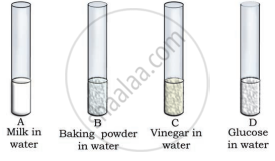
| Test tube | Nature of Solution | Change in colour of red litmus |
| A | Neutral | |
| B | Basic | |
| C | Acidic | |
| D | Neutral |
Advertisements
उत्तर
| Test tube | Nature of Solution | Change in colour of red litmus |
| A (Milk) | Neutral | No change |
| B (Baking powder) | Basic | Turn blue |
| C (Vinegar) | Acidic | No change |
| D (Glucose) | Neutral | No change |
APPEARS IN
संबंधित प्रश्न
Why indicator does not get affected by salt?
Write the balanced equation for the reaction of:
A named acid and a named alkali.
Give the significance of pH of soil in agriculture.
Write any four uses of bases.
Which of the following is not a base?
A solution changes the colour of turmeric indicator from yellow to red. The solution is ______.
State whether the following statement is true or false. Correct the false statement.
Lime water turns red litmus blue.
Water-soluble bases are called ______.
Which of the following solution is soapy to touch?
______ are bitter in taste.
