Advertisements
Advertisements
Question
Locomotion of starfish takes place through pseudopodia.
Options
True
False
Advertisements
Solution
False
APPEARS IN
RELATED QUESTIONS
Identify me.
My body is radially symmetrical. Water vascular system is present in my body. I am referred as fish though I am not. What is my name?
Write four distinguishing characters of phylum - Echinodermata.
Which of the following animals can regenerate it’s broken body part?
What are the locomotory organs of the animal given in the picture?

Write a short note.
Starfish
Water vascular system is found in ______.
How does locomotion take place in starfish?
Are jellyfish and starfish similar to fishes? If no justify the answer.
Hard calcium carbonate structures are used as skeleton by
Match items of column (A) with items of column (B)
| (A) | (B) | ||
| (a) | Pore bearing animals | (A) | Arthropoda |
| (b) | Diploblastic | (B) | Coelenterata |
| (c) | Metameric segmentation | (C) | Porifera |
| (d) | Jointed legs | (D) | Echinodermata |
| (e) | Soft bodied animals | (E) | Mollusca |
| (f) | Spiny skinned animals | (F) | Annelida |
______ is not a characteristic of Phylum Echinodertnata.
The locomotion of phylum Echinodermata is affected by ______.
Analogy:
Echinodermata: ______:: Soft Bodies Animals: ______.
Read the following statements.
- Metagenesis is observed in Helminths.
- Echinoderms are triploblastic and coelomate animals.
- Round worms have an organ-system level of body organization.
- Comb plates present in ctenophores help in digestion.
- Water vascular system is characteristic of Echinoderms.
Choose the correct answer from the options given below.
Identify the following animal and answer the questions that follow.
- Name its phylum.
- Name any two other examples of this phylum.
- Mention any two characters of this phylum.
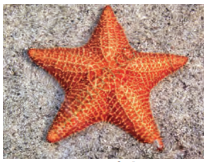
Cockroach, Frog, Sparrow, Starfish, from these animals which can regenerate its broken body part?
Read the statements and answer accordingly:
Calcareous spines are present on the body. Tube feet are used for locomotion and capturing prey also.
- Identify the phylum and give one example.
