Advertisements
Advertisements
Question
Match items of column (A) with items of column (B)
| (A) | (B) | ||
| (a) | Pore bearing animals | (A) | Arthropoda |
| (b) | Diploblastic | (B) | Coelenterata |
| (c) | Metameric segmentation | (C) | Porifera |
| (d) | Jointed legs | (D) | Echinodermata |
| (e) | Soft bodied animals | (E) | Mollusca |
| (f) | Spiny skinned animals | (F) | Annelida |
Advertisements
Solution
| (A) | (B) | ||
| (a) | Pore bearing animals | (C) | Porifera |
| (b) | Diploblastic | (B) | Coelenterata |
| (c) | Metameric segmentation | (F) | Annelida |
| (d) | Jointed legs | (A) | Arthropoda |
| (e) | Soft bodied animals | (E) | Mollusca |
| (f) | Spiny skinned animals | (D) | Echinodermata |
APPEARS IN
RELATED QUESTIONS
Identify the class of the animal shown in the figure and write any two characteristics.
Water vascular system is found in ______.
Which among the following is exclusively marine?
The locomotory organs of Echinodermata are
______ is not a characteristic of Phylum Echinodertnata.
______ separates the digestive tract from the body wall.
In the animals belonging to the phylum Echinodermata, the body is divided into head, muscular foot, and the visceral mass.
Which of the following animal does not belong to Phylum Echinodermata?
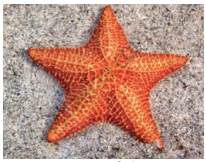
Identify the following animal and answer the questions that follow.
- Name its phylum.
- Name any two other examples of this phylum.
- Mention any two characters of this phylum.
Read the statements and answer accordingly:
Calcareous spines are present on the body. Tube feet are used for locomotion and capturing prey also.
- Identify the phylum and give one example.
