Advertisements
Advertisements
Question
Light waves each of amplitude "a" and frequency "ω", emanating from two coherent light sources superpose at a point. If the displacements due to these waves are given by y1 = a cos ωt and y2 = a cos(ωt + ϕ) where ϕ is the phase difference between the two, obtain the expression for the resultant intensity at the point.
Advertisements
Solution
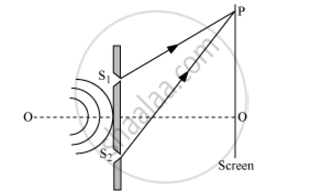
Let the displacement of the waves from the sources S1 and S2 at point P on the screen at any time t be given by:
y1 = a cos ωt
and
y2 = a cos (ωt + Φ)
where, Φ is the constant phase difference between the two waves
By the superposition principle, the resultant displacement at point P is given by:
y = y1 + y2
y = a cos ωt + a cos (ωt + Φ)
`=2a[cos((omegat+omegat+phi)/2)cos((omegat-omegat-phi)/2)]`
`y=2acos(omegat+phi/2)cos(phi/2)" ...(i)"`
Let 2 `acos(phi/2)=A ...(ii)"`
Then, equation (i) becomes:
`y=Acos(omegat+phi/2)`
Now, we have:
`A^2=4a^2cos^2(phi/2)" ..(iii)"`
The intensity of light is directly proportional to the square of the amplitude of the wave. The intensity of light at point P on the screen is given by:
`I=4a^2cos^2(phi/2)" ...(iv)"`
APPEARS IN
RELATED QUESTIONS
As you have learnt in the text, the principle of linear superposition of wave displacement is basic to understanding intensity distributions in diffraction and interference patterns. What is the justification of this principle?
A 4⋅0 kg block is suspended from the ceiling of an elevator through a string having a linear mass density of \[19 \cdot 2 \times {10}^{- 3} kg m^{- 1}\] . Find the speed (with respect to the string) with which a wave pulse can proceed on the string if the elevator accelerates up at the rate of 2⋅0 m s−2. Take g = 10 m s−2.
A heavy ball is suspended from the ceiling of a motor car through a light string. A transverse pulse travels at a speed of 60 cm s −1 on the string when the car is at rest and 62 cm s−1 when the car accelerates on a horizontal road. Find the acceleration of the car. Take g = 10 m s−2
A sonometer wire having a length of 1⋅50 m between the bridges vibrates in its second harmonic in resonance with a tuning fork of frequency 256 Hz. What is the speed of the transverse wave on the wire?
The energy in the superposition of waves ____________.
If `sqrt("A"^2+"B"^2)` represents the magnitude of resultant of two vectors `(vec"A" + vec"B")` and `(vec"A" - vec"B")`, then the angle between two vectors is ______.
Two particles P and Q describe simple harmonic motions of same amplitude a, frequency v along the same straight line. The maximum distance between the two particles is a`sqrt(2)`. The initial phase difference between the particles is
For the harmonic travelling wave y = 2 cos 2π (10t – 0.0080x + 3.5) where x and y are in cm and t is second. What is the phase difference between the oscillatory motion at two points separated by a distance of 0.5 m
For the harmonic travelling wave y = 2 cos 2π (10t – 0.0080x + 3.5) where x and y are in cm and t is second. What is the phase difference between the oscillatory motion at two points separated by a distance of `λ/2`
For the harmonic travelling wave y = 2 cos 2π (10t – 0.0080x + 3.5) where x and y are in cm and t is second. What is the phase difference between the oscillatory motion at two points separated by a distance of `(3λ)/4` (at a given instant of time)
