मराठी

Light Waves Each of Amplitude "a" and Frequency "ω", Emanating from Two Coherent Light Sources Superpose at a Point. - Physics

Advertisements
Advertisements

प्रश्न

Light waves each of amplitude "a" and frequency "ω", emanating from two coherent light sources superpose at a point. If the displacements due to these waves are given by y1 = a cos ωt and y2 = a cos(ωt + ϕ) where ϕ is the phase difference between the two, obtain the expression for the resultant intensity at the point.

Advertisements

उत्तर
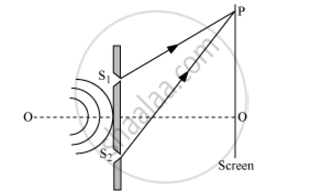
Let the displacement of the waves from the sources S1 and S2 at point P on the screen at any time t be given by:

y1 = a cos ωt

and

y2 = a cos (ωt + Φ)

where, Φ is the constant phase difference between the two waves

By the superposition principle, the resultant displacement at point P is given by:

y = y1 + y2

y = a cos ωt + a cos (ωt + Φ)

`=2a[cos((omegat+omegat+phi)/2)cos((omegat-omegat-phi)/2)]`

`y=2acos(omegat+phi/2)cos(phi/2)" ...(i)"`

Let 2 `acos(phi/2)=A ...(ii)"`

Then, equation (i) becomes:

`y=Acos(omegat+phi/2)`

Now, we have:

`A^2=4a^2cos^2(phi/2)" ..(iii)"`

The intensity of light is directly proportional to the square of the amplitude of the wave. The intensity of light at point P on the screen is given by:

`I=4a^2cos^2(phi/2)" ...(iv)"`

shaalaa.com
  या प्रश्नात किंवा उत्तरात काही त्रुटी आहे का?
2013-2014 (March) Delhi Set 1

व्हिडिओ ट्यूटोरियलVIEW ALL [2]

संबंधित प्रश्‍न

As you have learnt in the text, the principle of linear superposition of wave displacement is basic to understanding intensity distributions in diffraction and interference patterns. What is the justification of this principle?


A tuning fork of frequency 480 Hz is used to vibrate a sonometer wire having natural frequency 410 Hz. The wire will vibrate with a frequency


A heavy ball is suspended from the ceiling of a motor car through a light string. A transverse pulse travels at a speed of 60 cm s −1 on the string when the car is at rest and 62 cm s−1 when the car accelerates on a horizontal road. Find the acceleration of the car. Take g = 10 m s−2


Answer briefly.

State and explain the principle of superposition of waves.


Consider a ray of light incident from air onto a slab of glass (refractive index n) of width d, at an angle θ. The phase difference between the ray reflected by the top surface of the glass and the bottom surface is ______.


For the harmonic travelling wave y = 2 cos 2π (10t – 0.0080x + 3.5) where x and y are in cm and t is second. What is the phase difference between the oscillatory motion at two points separated by a distance of 0.5 m


For the harmonic travelling wave y = 2 cos 2π (10t – 0.0080x + 3.5) where x and y are in cm and t is second. What is the phase difference between the oscillatory motion at two points separated by a distance of `λ/2`


For the harmonic travelling wave y = 2 cos 2π (10t – 0.0080x + 3.5) where x and y are in cm and t is second. What is the phase difference between the oscillatory motion at two points separated by a distance of What is the phase difference between the oscillation of a particle located at x = 100 cm, at t = T s and t = 5 s?


In the interference of two sources of intensities I0 and 9I0 the intensity at a point where the phase difference is `pi/2` is ______.


When two coherent monochromatic light beams of intensities I and 4I are superimposed, then what are the maximum and minimum possible intensities in the resulting beams?


Share
Notifications

Englishहिंदीमराठी


      Forgot password?
Use app×