Advertisements
Advertisements
Question
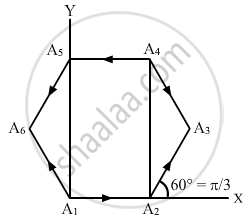
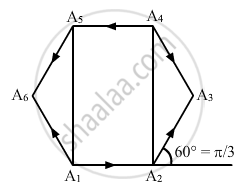
Let A1 A2 A3 A4 A5 A6 A1 be a regular hexagon. Write the x-components of the vectors represented by the six sides taken in order. Use the fact the resultant of these six vectors is zero, to prove that
cos 0 + cos π/3 + cos 2π/3 + cos 3π/3 + cos 4π/3 + cos 5π/3 = 0.
Use the known cosine values to verify the result.
Advertisements
Solution
According to the polygon law of vector addition, the resultant of these six vectors is zero.
Here, a = b = c = d = e = f (magnitudes), as it is a regular hexagon. A regular polygon has all sides equal to each other.
So, \[R_x = A \cos 0 + A \cos \frac{\pi}{3} + A \cos \frac{2\pi}{3} + A \cos \frac{3\pi}{3} + A \cos \frac{4\pi}{3} + A \cos \frac{5\pi}{3} = 0\]
[As the resultant is zero, the x-component of resultant Rx is zero]
\[\Rightarrow \cos 0 + \cos \frac{\pi}{3} + \cos \frac{2\pi}{3} + \cos\frac{3\pi}{3} + \cos \frac{4\pi}{3} + \cos \frac{5\pi}{5} = 0\]
Note: Similarly, it can be proven that
\[\sin 0 + \sin \frac{\pi}{3} + \sin \frac{2\pi}{3} + \sin \frac{3\pi}{3} + \sin \frac{4\pi}{3} + \sin \frac{5\pi}{3} = 0\]
APPEARS IN
RELATED QUESTIONS
If two quantities have same dimensions, do they represent same physical content?
A physical quantity is measured and the result is expressed as nu where u is the unit used and n is the numerical value. If the result is expressed in various units then
Find the dimensions of
(a) angular speed ω,
(b) angular acceleration α,
(c) torque τ and
(d) moment of interia I.
Some of the equations involving these quantities are \[\omega = \frac{\theta_2 - \theta_1}{t_2 - t_1}, \alpha = \frac{\omega_2 - \omega_1}{t_2 - t_1}, \tau = F . r \text{ and }I = m r^2\].
The symbols have standard meanings.
Find the dimensions of Planck's constant h from the equation E = hv where E is the energy and v is the frequency.
Theory of relativity reveals that mass can be converted into energy. The energy E so obtained is proportional to certain powers of mass m and the speed c of light. Guess a relation among the quantities using the method of dimensions.
Let I = current through a conductor, R = its resistance and V = potential difference across its ends. According to Ohm's law, product of two of these quantities equals the third. Obtain Ohm's law from dimensional analysis. Dimensional formulae for R and V are \[{\text{ML}}^2 \text{I}^{- 2} \text{T}^{- 3}\] and \[{\text{ML}}^2 \text{T}^{- 3} \text{I}^{- 1}\] respectively.
Test if the following equation is dimensionally correct:
\[h = \frac{2S cos\theta}{\text{ prg }},\]
where h = height, S = surface tension, ρ = density, I = moment of interia.
Test if the following equation is dimensionally correct:
\[V = \frac{\pi P r^4 t}{8 \eta l}\]
where v = frequency, P = pressure, η = coefficient of viscosity.
Can a vector have zero component along a line and still have nonzero magnitude?
A vector is not changed if
Which of the sets given below may represent the magnitudes of three vectors adding to zero?
Let \[\vec{C} = \vec{A} + \vec{B}\]
Two vectors have magnitudes 2 unit and 4 unit respectively. What should be the angle between them if the magnitude of the resultant is (a) 1 unit, (b) 5 unit and (c) 7 unit.
A spy report about a suspected car reads as follows. "The car moved 2.00 km towards east, made a perpendicular left turn, ran for 500 m, made a perpendicular right turn, ran for 4.00 km and stopped". Find the displacement of the car.
A mosquito net over a 7 ft × 4 ft bed is 3 ft high. The net has a hole at one corner of the bed through which a mosquito enters the net. It flies and sits at the diagonally opposite upper corner of the net. (a) Find the magnitude of the displacement of the mosquito. (b) Taking the hole as the origin, the length of the bed as the X-axis, it width as the Y axis, and vertically up as the Z-axis, write the components of the displacement vector.
Give an example for which \[\vec{A} \cdot \vec{B} = \vec{C} \cdot \vec{B} \text{ but } \vec{A} \neq \vec{C}\].
Write the number of significant digits in (a) 1001, (b) 100.1, (c) 100.10, (d) 0.001001.
