Advertisements
Advertisements
Question
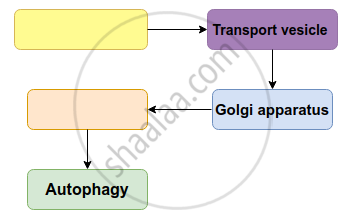
Label the diagram and write down the detail of the concept in your word.

Advertisements
Solution
Golgi complex or Golgi apparatus or Golgi body act as an assembly, manufacturing cum packaging, and transport unit of the cell.
- Structure of the Golgi complex:
- Golgi complex consists of stacks of membranous sacs called cisternae.
- Diameter of cisternae varies from 0.5 to 1µm.
- A Golgi complex may have few to several cisternae depending on its function.
- The thickness and molecular composition of membranes at one end of the stack of a Golgi sac differ from those at the other end.
- The Golgi sacs show specific orientation in the cell.
- Each cisterna has a forming or ‘cis’ face (cis: on the same side) and maturing or ‘trans’ face (trans: the opposite side).
- Transport vesicles that pinch off from transitional ER merge with cis face of Golgi cisterna and add its contents into the lumen.
- Location of Golgi complex:
Golgi bodies are usually located near the endoplasmic reticulum. - Functions of Golgi complex:
- Golgi body carries out two types of functions, modification of secretions of ER and production of its own secretions.
- Cisternae contain specific enzymes for specific functions.
- Refining (modification) of the product takes place in a sequential manner.
- For example, certain sugar component is added or removed from glycolipids and glycoproteins that are brought from ER, thus forming a variety of products.
- Golgi bodies also manufacture their own products. Golgi bodies in many plant cells produce noncellulose polysaccharides like pectin.
- Manufactured or modified, all products of Golgi complex leave cisternae from trans face as transport vesicles.
APPEARS IN
RELATED QUESTIONS
Choose the correct option.
Cell Wall is present in
Choose the correct option.
Plasma membrane is ______.
Mitochondria DNA is ______.
Choose the correct option.
Lysosomes are not help full in ______.
Choose the correct option.
Golgi body is absent in
Answer the following question.
Plants have no circulatory system? Then how cells manage intercellular transport?
Answer the following question.
Mitochondria are power house of the cell. Give reasons.
Label the diagram and write down the detail of the concept in your word.

Complete the flow chart.
Onion cells have no chloroplast. How can we tell they are plants?
