Advertisements
Advertisements
Question
|
‘Kolam’ is a decorative art which is made with rice flour in South Indian States. It is drawn on grid pattern of dots. One such art work is shown below.
|
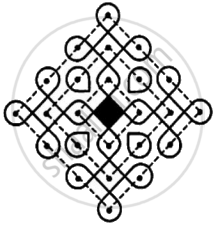
Based on the above, answer the following questions:
(i) Show that number of dots given above form an A.P. Write the first term and common differencе. [1]
(ii) Write nth term of the A.P. formed. [1]
(iii) (a) The pattern is expanded on a large ground. If total 220 dots are used, then find the number of squares formed. [2]
OR
(b) Is it possible to complete n number of squares using 100 dots? If yes, then find the value of n.
Advertisements
Solution
(i) The number of dots in the successive squares are:
First square (a1) = 4
Second square (a2) = 8
Third square (a3) = 12
The differences between consecutive terms:
a2 – a1 = 8 – 4 = 4
a3 – a2 = 12 – 8 = 4
Since the difference between consecutive terms is constant (d = 4), the sequence forms an Arithmetic Progression.
The first term (a) is 4 and the common difference (d) is 4.
(ii) First term (a) = 4
Common difference (d) = 4
The nth term:
an = a + (n – 1)d
an = 4 + (n – 1)4
an = 4n
The nth term of the A.P. is 4n.
(iii) (a) Given: Sn = 220, a = 4, d = 4.
The sum of the first n terms of an A.P. is:
`S_n = n/2 [2a + (n - 1)d]`
`220 = n/2 [2(4) + (n - 1)4]`
`220 = n/2 [8 + 4n - 4]`
`220 = n/2 [4n + 4]`
`220 = n/2 xx 4(n + 1)`
220 = 2n(n + 1)
110 = n2 + n
n2 + n – 110 = 0
n2 + 11n = 10n – 110 = 0
n(n + 11) – 10(n + 11) = 0
(n – 10)(n + 11) = 0
Since the number of squares (n) cannot be negative, we have n = 10.
The total number of squares formed is 10.
OR
(b) Let Sn = 100 and check if the resulting n is a natural number.
Sn = 2n2 + 2n
2n2 + 2n = 100
n2 + n = 50
n2 + n – 50 = 0
Using the quadratic formula `n = (-b ± sqrt(b^2 - 4ac))/(2a)`
Here a = 1, b = 1, c = –50.
D = b2 – 4ac
= 12 – 4(1)(–50)
= 1 + 200
= 201
For n to be an integer, the discriminant (D) must be a perfect square.
Since 201 is not a perfect square (142 = 196 and 152 = 225), the value of n will not be a natural number.
Therefore, it is not possible to complete an exact number of squares using exactly 100 dots.
No, It is not possible because n is not a natural number.
