Advertisements
Advertisements
Question
|
Point A: (–4, 2) Rajasthan High Court Point B: (4, –4) Birla Mandir Point C: (4, 3) Heera Bagh Point D: (–5, –2) Amar Jawan Jyoti |
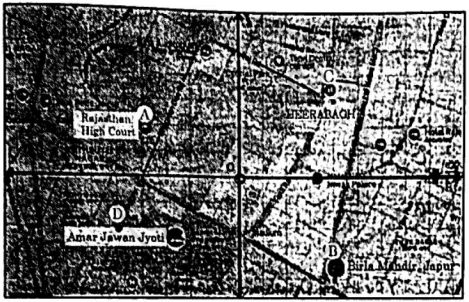
Based on the above, answer the following questions:
(i) Advocate Rehana stays at Heera Bagh. How much distance she has to cover daily to go to the court and coming back home? [1]
(ii) There is a crossing on X-axis which divides AD in a certain ratio. Find the ratio. [1]
(iii) (a) Is Birla Mandir equidistant from Heera Bagh and Amar Jawan Jyoti? Justify your answer. [2]
OR
(b) Using section formula, show that points A, O and B are not collinear.
Advertisements
Solution
(i) Given:
A = (–4, 2)
C = (4, 3)
One-way distance (CA):
Distance `d_(CA) = sqrt((x_2 - x_1)^2 + (y_2 - y_1)^2`
`d_(CA) = sqrt((-4 - 4)^2 + (2 - 3)^2`
`d_(CA) = sqrt((-8)^2 + (-1)^2`
`d_(CA) = sqrt(64 + 1)`
`d_(CA) = sqrt(65)` units
Daily total distance (Round trip) = `2 xx sqrt(65) = 2sqrt(65)` units.
The total distance covered dally is `2sqrt(65)` units.
(ii) Let the ratio be k : 1. The point on the X-axis is (x, 0).
Point A is (4, 2) and Point D is (–5, –2).
Using the Y-coordinate:
`y = (my_2 + ny_1)/(m + n)`
`0 = (k(-2) + 1(2))/(k + 1)`
0 = –2k + 2
2k = 2
k = 1
Thus, the ratio is 1 : 1.
(iii) (a) Equidistant means the distance from Birla Mandir (B) to Heera Bagh (C) must be equal to the distance from Birla Mandir (B) to Amar Jawan Jyoti (D).
B = (4, –4), C = (4, 3) and D = (–5, –2)
Distance BC:
`BC = sqrt((x_2 - x_1)^2 + (y_2 - y_1)^2`
`BC = sqrt((4 - 4)^2 + (3 - (-4))^2`
`BC = sqrt(0^2 + 7^2)`
BC = 7 units
Distance BD:
`BD = sqrt((x_2 - x_1)^2 + (y_2 - y_1)^2`
`BD = sqrt((-5 - 4)^2 + (-2 - (-4))^2`
`BD = sqrt((-9)^2 + 2^2)`
`BD = sqrt(81 + 4)`
`BD = sqrt(85)` units
Since `7 ≠ sqrt(85)`, BC ≠ BD.
No, Birla Mandir is not equidistant from the two places because the distances calculated are unequal.
OR
(b) Assume O divides AB in ratio k : 1.
A = (–4, 2), O = (0, 0) and B = (4, –4)
Using the X-coordinate of O:
`0 = (k(4) + 1(-4))/(k + 1)`
4k – 4 = 0
⇒ k = 1
If collinear, O must divide AB in ratio 1 : 1.
Let’s check this ratio using the Y-coordinate. If k = 1, the Y-coordinate should be:
`y = (1(-4) + 1(2))/(1 + 1)`
= `(-2)/2`
= –1
But the Y-coordinate of O is 0. Since 0 ≠ –1, the point O does not lie on the line segment AB in a single consistent ratio.
Since the ratios for X and Y coordinates do not match, the points A, O and B are not collinear.
