Advertisements
Advertisements
Question
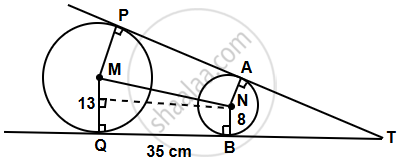
In the given figure, TP and TQ are tangents to a circle with centre M, touching another circle with centre N at A and B respectively. It is given that MQ = 13 cm, NB = 8 cm, BQ = 35 cm and TP = 80 cm.
- Name the quadrilateral MQBN. [1]
- Is MN parallel to PA? Justify your answer. [1]
- Find length TB. [1]
- Find length MN. [2]
Advertisements
Solution
i. In quadrilateral MQBN, MQ ⊥ TQ and NB ⊥ TQ (Radius ⊥ Tangent).
Since both are perpendicular to the same line TQ, MQ || NB.
A quadrilateral with one pair of opposite sides parallel is a Trapezium.
ii. No, MN is not parallel to PA. PA is a chord/segment on the tangents, while MN is the line joining the centers. There is no geometric condition satisfyng parallelism here.
iii. Since TP and TQ are tangents from T to the circle with center M, TP = TQ = 80 cm.
Now, TQ = TB + BQ.
80 = TB + 35
⇒ TB = 45 cm
iv. We know MQ || NB. To find the distance between centers MN in trapezium MQBN:
Draw a line from N perpendicular to MQ, say at point X.
QX = NB = 8 cm.
MX = MQ – QX
= 13 – 8
= 5 cm
In right △MXN, NX = BQ = 35 cm.
MN2 = MX2 + NX2
= 52 + 352
= 25 + 1225
= 1250
MN = `sqrt(1250)`
= `25sqrt(2)`
= 35.36 cm
