Advertisements
Advertisements
Question
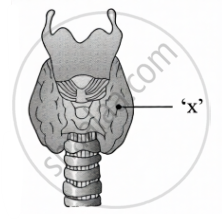
Is the following gland an exocrine or an endocrine gland?
Thyroid gland
Options
Exocrine Gland
Endocrine Gland
Advertisements
Solution
Endocrine Gland
RELATED QUESTIONS
Given below is a table designed to give the names of the glands, the hormones produced, their chief functions, the effects of oversecretion and undersecretion in respect of thyroid, pituitary and pancreas. Fill up the blanks 1–13.
| S.No. | Source Gland cells | Hormone produced | Chief function | Effect of oversecretion | Effect of undersecretion |
| 1 | (1) ______ | Thyroxine | (2) ______ | (3) ______ | (4) ______ |
| 2 | Beta cells of Islets of Langerhans | (5) ______ | Promotes glucose utilisation by the body cells | (6) ______ | (7) ______ |
| 3 | (8) ______ | Growth hormone | (9) ______ | (10) ______ | Dwarfism |
| 4 | (11) ______ | Vasopressin | Increases reabsorption of water from kidney tubule | (12) ______ | (13) ______ |
Define the following:
Exophthalmic goiter
Give a labeled diagram of parathyroid gland.
Hormone thyroxine, adrenaline, and nonadrenaline are formed from _____________.
The growth and functions of the thyroid gland are controlled by ______.
Senthil has high blood pressure, protruded eyeball, and an increased body temperature. Name the endocrine gland involved and the hormone secretion responsible for this condition.
Which diseases is caused by the hypersecretion of mineralocorticoids and glucocorticoids?
Which hormone is produced by the parafollicular cells?
Hormone controlling metabolism is ______.
Identify label ‘X’ from the given diagram and name the cells, which regulate concentration of calcium and phosphorous in the blood and select the correct option given below.