Advertisements
Advertisements
Question
Is it possible for two bodies to be in thermal equilibrium if they are not in contact?
Advertisements
Solution
Two bodies are said to be in thermal equilibrium if they are at the same temperature. Consider two bodies A and B that are not in contact with each other but in contact with a heat reservoir. Since both the bodies will attain the temperature of the reservoir, they will be at the same temperature and, hence, in thermal equilibrium. Therefore, it is possible to have two bodies in thermal equilibrium even though they are not in contact.
APPEARS IN
RELATED QUESTIONS
If two bodies are in thermal equilibrium in one frame, will they be in thermal equilibrium in all frames?
A system X is neither in thermal equilibrium with Y nor with Z. The systems Y and Z
A steel rod is clamped at its two ends and rests on a fixed horizontal base. The rod is unstrained at 20°C.
Find the longitudinal strain developed in the rod if the temperature rises to 50°C. Coefficient of linear expansion of steel = 1.2 × 10⁻⁵ °C–1.
An iron plate has a circular hole of a diameter 11 cm. Find the diameter of the hole when the plate is uniformly heated from 10° C to 90° C.`[alpha = 12 xx 10^-6//°"C"]`
A metal sphere 10.01 cm in diameter is placed on a brass ring of internal diameter 10 cm and at the same temperature of 12° C. The temperature up to which they should be heated together so that the metal sphere just passes through the ring is `[alpha_"metal"= 12 xx 10^-6//°"C" and alpha_"brass" =18 xx 10^-6//°"C"]` ____________.
The volume of a metal block changes by 0.86% when heated through 200 °C then its coefficient of cubical expansion is ______.
An aluminium sphere is dipped into water. Which of the following is true?
As the temperature is increased, the time period of a pendulum ______.
Calculate the stress developed inside a tooth cavity filled with copper when hot tea at temperature of 57°C is drunk. You can take body (tooth) temperature to be 37°C and α = 1.7 × 10⁻⁵/°C, bulk modulus for copper = 140 × 109 N/m2.
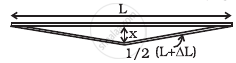
A rail track made of steel having length 10 m is clamped on a raillway line at its two ends (figure). On a summer day due to rise in temperature by 20° C, it is deformed as shown in figure. Find x (displacement of the centre) if αsteel = 1.2 × 10⁻⁵/°C.
The height of mercury column measured with brass scale at temperature T0 is H0. What height H' will the mercury column have at T = 0°C. Coefficient of volume expansion of mercury is γ. Coefficient of linear expansion of brass is α ______.
A metal ball immersed in water weighs w1 at 0°C and w2 at 50°C. The coefficient of cubical expansion of metal is less than that of water. Then ______.
A disc is rotating freely about its axis. The percentage change in angular velocity of a disc if temperature decreases by 20°C is ______.
(coefficient of linear expansion of material of disc is 5 × 10⁻⁴/°C)
A solid metallic cube having a total surface area of 24 m2 is uniformly heated. If its temperature is increased by 10°C, calculate the increase in the volume of the cube.
(Given: α = 5.0 × 10⁻⁴°C−1)
When heat is given to a substance, it generally ______.
The increase in the dimensions of a body due to an increase in its temperature is called ______.
