Advertisements
Advertisements
Question
Is it possible that an object is in a state of accelerated motion due to external force acting on it, but no work is being done by the force? Explain it with an example.
Advertisements
Solution
Yes, it is possible that an object is in a state of accelerated motion due to external force acting on it, but no work is being done by the force.
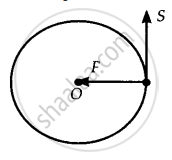
For example, an object moving in a circular path due to centripetal force acting on it.
At any instant of time, a constant acceleration due to the centripetal force act on the object along the radius towards the centre while the direction of displacement is tangential to the circle. That is, force and displacement are perpendicular to each other and hence no work is being done.
APPEARS IN
RELATED QUESTIONS
State the energy changes in the following case while in use:
A ceiling fan
State the energy changes that occur in the following :
An electric generator (or dynamo).
State the energy changes in the following case while in use:
A solar cell
A metal ball of mass 2 kg is allowed to fall freely from rest from a height of 5 m above the ground. What happens to the mechanical energy after the ball hits the ground and comes to rest?
A rocket is moving up with a velocity v. If the velocity of this rocket is suddenly tripled, what will be the ratio of two kinetic energies?
Avinash can run with a speed of 8 m s–1 against the frictional force of 10 N, and Kapil can move with a speed of 3 m s–1 against the frictional force of 25 N. Who is more powerful and why?
Can any object have mechanical energy even if its momentum is zero? Explain.
The velocity of a body moving in a straight line is increased by applying a constant force F, for some distance in the direction of the motion. Prove that the increase in the kinetic energy of the body is equal to the work done by the force on the body.
The energy conversion in a washing machine is from ______.
For burning of coal in a thermoelectric station, the energy conversion taking place is:
