Advertisements
Advertisements
Question
In what ways did the bear become the lady’s pet animals?
Advertisements
Solution
The lady gave milk to the half-dead bear and brought him up. The bear was friendly towards the dogs, children, and other cattle grazing in the field. In this way, he became the lady’s pet animal.
RELATED QUESTIONS
Answer these question in a few words or a couple of sentence.
What things about the book did she find strange?
Thinking about the Poem
What does the poet wish for the snake?
Read a short story about an exemplary boss.
|
Working 12 to 18 hours a day was not uncommon for scientists at the rocket launching station, Thumba. A group of such scientists was frustrated due to the work pressure and meeting their boss's demands; however, they were loyal to him. With a jolt he remembered his promise to his children. He looked for his boss who was not in his omee. Having told him just that morning. he wrapped up his work and hurried home. |
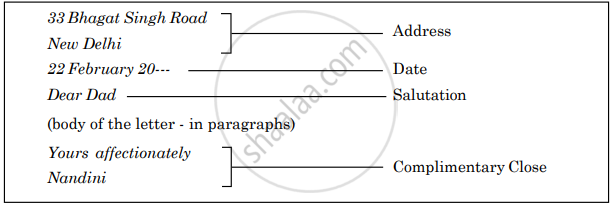
When we write informal letters (to a friend, or to a member of our family), we use this layout.
Six humans trapped by happenstance
In black and bitter cold.
Each one possessed a stick of wood,
Or so the story's told.
Their dying fire in need of logs;
The first man held his back.
For on the faces around the fire,
He noticed one was black.
Read the lines given above and answer the question that follow:
Which sin is hinted at in these lines?
"My father lived at Blenheim then,
Yon little stream hard by;
They burnt his dwelling to the ground,
And he was forced to fly;
So with his wife and child he fled,
Nor had he where to rest his head.
"With fire and sword the country round
Was wasted far and wide,
And many a childing mother then,
And new-born baby died;
But things like that, you know, must be
At every famous victory;
Read the lines given above and answer the question that follow.
Explain with reference to context.
To us the ashes of our ancestors are sacred and their resting place is hallowed ground. You wander far from the graves of your ancestors and seemingly without regret. Your religion was written upon tablets of stone by the iron finger of your God so that you could not forget. The Red Man could never comprehend or remember it. Our religion is the traditions of our ancestors — the dreams of our old men, given them in solemn hours of the night by the Great Spirit; and the visions of our sachems, and is written in the hearts of our people.
Day and night cannot dwell together. The Red Man has ever fled the approach of the White Man, as the morning mist flees before the morning sun. However, your proposition seems fair and I think that my people will accept it and will retire to the reservation you offer them. Then we will dwell apart in peace, for the words of the Great White Chief seem to be the words of nature speaking to my people out of dense darkness.
Read the extract given below and answer the question that follow.
Why do the dead of the Tribals never forget them or this beautiful world?
He flungs himself down in a corner to recoup from the fatigue of his visit to the shop. His wife said, “You are getting no sauce today, nor anything else. I can’t find anything to give you to eat. Fast till the evening, it’ll do you good. Take the goats and be gone now,” she cried and added, “Don’t come back before the sun is down.”
Read the extract given below and answer the question that follow.
Where had Muni gone and why?
“I love the West,” said the girl irrelevantly. Her eyes were shining softly. She looked away out the car window. She began to speak truly and simply without the gloss of style and manner: “Mamma and I spent the summer in Deliver. She went home a week ago
because father was slightly ill. I could live and be happy in the West. I think the air here agrees with me. Money isn’t everything. But people always misunderstand things and remain stupid—” “Say, Mr. Marshal,” growled the glum-faced man. “This isn’t quite fair. I’m needing a drink, and haven’t had a smoke all day. Haven’t you talked long enough? Take me in the smoker now, won’t you? I’m half dead for a pipe.”
The bound travellers rose to their feet, Easton with the Same slow smile on his face. “I can’t deny a petition for tobacco,” he said, lightly. “It’s the one friend of the unfortunate. Good-bye, Miss Fairchild. Duty calls, you know.” He held out his hand for a farewell. “It’s too bad you are not going East,” she said, reclothing herself with manner and style. “But you must go on to Leavenworth, I suppose?” “Yes,” said Easton, “I must go on to Leavenworth.”
The two men sidled down the aisle into the smoker. The two passengers in a seat near by had heard most of the conversation. Said one of them: “That marshal’s a good sort of chap. Some of these Western fellows are all right.” “Pretty young to hold an office like that, isn’t he?” asked the other. “Young!” exclaimed the first speaker, “why—Oh! didn’t you catch on? Say—did you ever know an officer to handcuff a prisoner to his right hand?”
Read the extract given below and answer the question that follow.
What ironical twist is revealed by the other passenger in the end?
Why did Vijay Singh ask the ghost disguised as Natwar to come closer?
To whom are these instructions being addressed?
Who is the ‘he’ in the line "I couldn’t quite hear what he said" of the extract?
Answer the following question. (Refer to that part of the text whose number is given against the question. This applies to the comprehension questions throughout the book.)
How did Patrick help him? (7)
Complete the following sentence.
The young boy spent his afternoons in the tree ________.
When did the banyan tree become a noisy place?
Talk to your partner and say whether the following statement is true or false.
Most snakes are harmless.
The lane is dark and lonely because __________.
Read the lines given below and answer the following question:
| “But my darling, if you love me,” thought Miss Meadows, “I don’t Mind how much it is. Love me as little as you like.” |
Where was Miss Meadows as she thought these thoughts?
What does Prospero intend to do with his book before his interaction with Alonso in Act V of the play, The Tempest?
What aspect of shylock's nature is revealed in his words, "To bait fish withal; if it will feed nothing else, it will feed any revenge"?
