Advertisements
Advertisements
Question
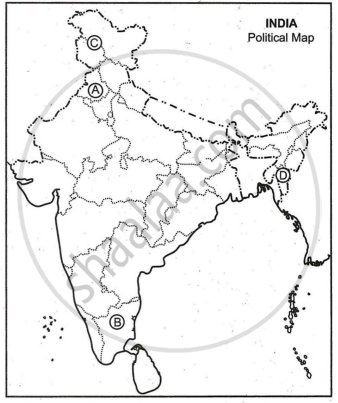
In the given political outline map of India, four states have been marked as (A), (B), (C) and (D). Identify these states on the basis of the information given below and write their correct names in your answer book along with the respective serial number of the information used and the concerned alphabets given in the ‘map as per the format that follows:
| S.No.of the information used |
Concerned Alphabet |
Name of the State |
| (i) | ||
| (ii) | ||
| (iii) | ||
| (iv) |
- The state which has been bifurcated in two Union Territories recently.
- The state where Rajiv Gandhi-Longowal Accord was signed.
- The state to which Laldenga belonged.
- The state from where the Dravidian Movement started.
Advertisements
Solution
| S.No. of the information used |
Concerned Alphabet |
Name of the State |
| (i) | C | Jammu & Kashmir |
| (ii) | A | Punjab |
| (iii) | D | Mizoram |
| (iv) | B | Tamil Nadu |
APPEARS IN
RELATED QUESTIONS
The First Home Minister of independent India was ____________.
The states created in 1960 were:
When Gujarat was carved out of Bombay?
Which state was not created in 2000?
When Meghalaya was carved out of Assam?
Name the original state from which Chattisgarh was carved out.
Which one of the following is a princely state of India that initially resisted joining the Indian Union?
Which one of the following leaders played a vital role in the integration of princely states with India?
How many princely states existed at the time of independence of India?
When Gujarat was carved out of Bombay?
The Nizam wanted an independent status for Hyderabad. He entered into what was called the standstill agreement with India in November 1947 for ______ while negotiations with the Indian Government were going on.
Choose the odd one out of the following statements.
Match the principles with instances:
| (a) | Mapping of boundaries on religious grounds | (i) | Pakistan and Bangladesh |
| (b) | Mapping of boundaries on grounds of different languages | (ii) | India and Pakistan |
| (c) | Demarcating boundaries within a country by geographical zones | (iii) | Jharkhand and Chhattisgarh |
| (d) | Demarcating boundaries within a country on administrative and political grounds | (iv) | Himachal Pradesh and Uttarakhand |
Indian Government had taken a firm stand to prevent possible division of the country into small principalities after independence. Consider the following statements in this regard-
- Government showed more rigidity towards giving autonomy to these princely states.
- Accession of princely states of Junagarh, Hyderabad, Kashmir, and Manipur ·proved more difficult than the rest
Choose the correct statement-
Who played an important role in the integration of Princely States with India?
Which one of the following leaders played an important role in the integration of the princely states with India?
Which princely state of India was the first to announce the remain as an independent state?
Which of the following states initially refused to join the Indian Union?
Which group among the following options represents the three princely states that resisted their merger with India?
A paramilitary force of Nizam of Hyderabad which was sent to respond people's movement was known as ______.
What do you understand by the 'British paramountcy or suzerainty'?
Evaluate Sardar Patel’s role in the integration of princely states with Indian Union.
