Advertisements
Advertisements
Question
In the given figure, PQRS is a trapezium in which PQ ‖ SR and PS = QR. Prove that: ∠PSR = ∠QRS and ∠SPQ = ∠RQP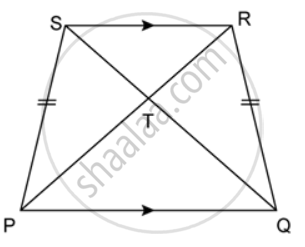
Advertisements
Solution
Construction:
Draw SM ⊥ PQ and RN ⊥ PQ
a. In ΔPMS and ΔQNR,
PS = QR ....(given)
∠PMS = ∠QNR ....(Each 90°)
SM = RN ....(Distance between parallel lines)
∴ ΔPMS ≅ ΔQNR ....(RHS congruence)
⇒ ∠PM = ∠RQN
⇒ ∠SPQ = ∠RQP
⇒ ∠PSR = ∠QRS ....(Supplement of each angle SPQ and RQP)
b. In ΔPQS and ΔQPR,
PS = QR ....(given)
∠SPQ = ∠RQP ....(proved)
PQ = PQ ....(common)
∴ ΔPQS ≅ ΔQPR ....(SAS congruence)
⇒ QS = PR ....(proved)
⇒ PSQ = ∠QRP ....(i)
c. In ΔTPS and ΔTQR,
PS = QR ....(given)
∠STP = ∠RTQ ....(Vertically opposite angles)
∠PST = ∠QRT ....[From (i)]
∴ ΔTPS ≅ ΔTQR ....(SAS congruence)
⇒ TP = TQ ....(proved)
⇒ TS = TR. ....(proved)
RELATED QUESTIONS
SN and QM are perpendiculars to the diagonal PR of parallelogram PQRS.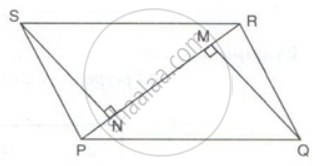
Prove that:
(i) ΔSNR ≅ ΔQMP
(ii) SN = QM
ABCD is a rectangle with ∠ADB = 55°, calculate ∠ABD.
Prove that if the diagonals of a parallelogram are equal then it is a rectangle.
In a parallelogram PQRS, M and N are the midpoints of the opposite sides PQ and RS respectively. Prove that
RN and RM trisect QS.
ABCD is a trapezium in which side AB is parallel to side DC. P is the mid-point of side AD. IF Q is a point on the Side BC such that the segment PQ is parallel to DC, prove that PQ = `(1)/(2)("AB" + "DC")`.
In the given figure, PQRS is a parallelogram in which PA = AB = Prove that: SA ‖ QB and SA = QB.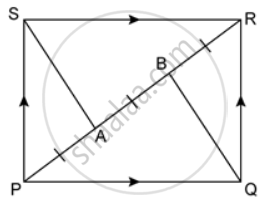
In the given figure, AB ∥ SQ ∥ DC and AD ∥ PR ∥ BC. If the area of quadrilateral ABCD is 24 square units, find the area of quadrilateral PQRS.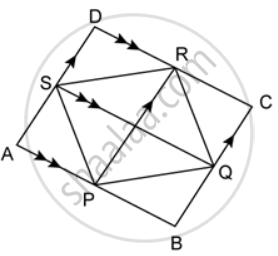
In ΔABC, the mid-points of AB, BC and AC are P, Q and R respectively. Prove that BQRP is a parallelogram and that its area is half of ΔABC.
In ΔPQR, PS is a median. T is the mid-point of SR and M is the mid-point of PT. Prove that: ΔPMR = `(1)/(8)Δ"PQR"`.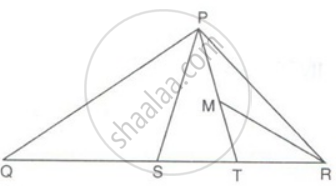
In the figure, ABCD is a parallelogram and CP is parallel to DB. Prove that: Area of OBPC = `(3)/(4)"area of ABCD"`