Advertisements
Advertisements
Question
In the given figure, AB = AC, AP = AQ. Prove that
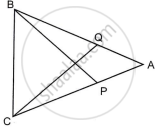
- ΔCAQ ≅ ΔBAP
- ΔBQC ≅ ΔCPB
Advertisements
Solution
To prove the congruence of triangles ΔCAQ and ΔBAP and ΔBQC and ΔCPB, let’s carefully examine the given conditions:
Given:
- AB = AC ...(Triangle ABC is isosceles)
- AP = AQ ...(Given)
To Prove:
- ΔCAQ ≅ ΔBAP,
- ΔBQC ≅ ΔCPB.
Proof for i: ΔCAQ ≅ ΔBAP
We are given that AB = AC and AP = AQ.
We now need to prove that triangles ΔCAQ and ΔBAP are congruent.
- Side AB = AC ...(Given)
- Side AP = AQ ...(Given)
- Angle ∠BAP = ∠CAQ ...(Since they are vertically opposite angles formed by the intersection of line segments AB and AC)
By the Side-Angle-Side (SAS) Congruence Theorem, if two sides and the included angle of one triangle are equal to two sides and the included angle of another triangle, then the two triangles are congruent.
Therefore, since:
AB = AC,
AP = AQ,
∠BAP = ∠CAQ,
We can conclude that ΔCAQ ≅ ΔBAP by SAS Congruence Theorem.
Proof for ii: ΔBQC ≅ ΔCPB
Now, we need to prove that ΔBQC and ΔCPB are congruent.
-
Side BQ = CP ...(Since AP = AQ and AP and AQ are on the same line segment, they must be equal in length)
-
Side BC = BC ...(Common side)
-
Angle ∠BQC = ∠CPB ...(These are vertically opposite angles, formed by the intersection of line segments)
By the Side-Angle-Side (SAS) Congruence Theorem, we have:
BQ = CP
BC = BC ...(Common side)
∠BQC = ∠CPB ...(Vertically opposite angles)
Thus, we can conclude that ΔBQC ≅ ΔCPB by SAS Congruence Theorem.
