Advertisements
Advertisements
Question
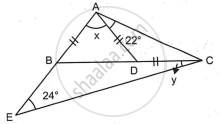
In ΔABC, AB = AD = DC and AB is extended to E. ∠DAC = 22° and ∠E = 24°. Find angles x and y.
Advertisements
Solution
To solve for x and y in triangle ABC with the given conditions, we can follow these steps:
Given:
AB = AD = DC, meaning triangle ABD and triangle DCB are isosceles.
AB is extended to E, forming a straight line.
∠DAC = 22° and ∠E = 24° where E is on the extension of AB.
Step 1: Use the Property of Straight Line
Since AB is extended to E, we know that ∠E = 24° an exterior angle at point E.
Since AB is a straight line, we also know that ∠DAB + ∠E = 180° straight line sum.
Thus, 22° + ∠E = 180°
⇒ 22° + 24°
= 180°
This confirms the angles on the straight line add up correctly.
Step 2: Analyze Triangle ABD and Triangle DCB
Since AB = AD = DC, triangles ABD and DCB are both isosceles, meaning:
∠ABD = ∠ADB ...(Because AB = AD)
∠BDC = ∠DCB ...(Because DC = DB)
Step 3: Solve for Angles in Triangle ABD
Now, since AB = AD, triangle ABD is isosceles.
Therefore, ∠ABD = ∠ADB = x.
Let’s denote these equal angles by x.
The sum of the angles in triangle ABD is 180°:
∠DAB + ∠ABD + ∠ADB = 180°
Substitute the known values:
22° + x + x = 180°
⇒ 2x = 158°
⇒ x = 79°
Step 4: Solve for Angle y in Triangle DCB
In triangle DCB, since DC = DB, we know triangle DCB is isosceles.
Therefore, ∠DCB = ∠BDC = y.
Let’s denote these equal angles by y.
The sum of the angles in triangle DCB is 180°:
∠DCB + ∠BDC + ∠BCD = 180°.
We already know that ∠BCD = 24° since it is the same as ∠E, which is given as 24°.
Thus, y + y + 24° = 180°
⇒ 2y = 156°
⇒ y = 78°
Final Values:
x = 92°
y = 20°
