Advertisements
Advertisements
Question
In the figure, given that ∠1 = ∠2 and ∠3 ≡ ∠4. Prove that ∆MUG ≡ ∆TUB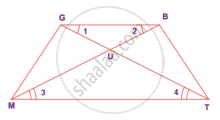
Advertisements
Solution
| Statements | Reasons |
|
1. In ΔMUG and ΔTUG MU = TU |
∠3 = ∠4, opposite sides of equal angles |
| 2. UG = UB |
∠1 = ∠2 Side opposite to equal angles are equal |
| 3. ∠GUM = ∠BUT | Vertically opposite angle |
| 4. ∆MUG ≡ ∆TUG |
SAS criteria By 1, 2 and 3 |
APPEARS IN
RELATED QUESTIONS
State whether the two triangles are congruent or not. Justify your answer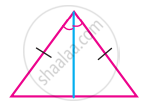
For the given pair of triangles state the criterion that can be used to determine the congruency?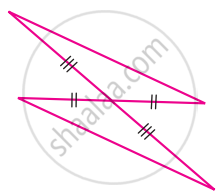
Construct a triangle ABC with given conditions.
AB = 7 cm, AC = 6.5 cm and ∠A = 120°
Construct a triangle PQR with given conditions.
∠P = 115°, ∠Q = 40° and PQ = 6 cm
In ∆ABC and ∆PQR, ∠A = 50° = ∠P, PQ = AB, and PR = AC. By which property ∆ABC and ∆PQR are congruent?
In the following figure, ∆PQR ≅ ∆ ______.
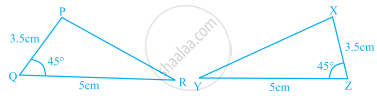
In the following figure, two triangles are congruent by RHS.

In the following figure, which pairs of triangles are congruent by SAS congruence criterion (condition)? if congruent, write the congruence of the two triangles in symbolic form.
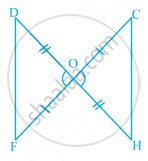
State which of the following pairs of triangles are congruent. If yes, write them in symbolic form (you may draw a rough figure).
∆ABC: AB = 4.8 cm, ∠A = 90°, AC = 6.8 cm
∆XYZ: YZ = 6.8 cm, ∠X = 90°, ZX = 4.8 cm
In the following figure, DE = IH, EG = FI and ∠E = ∠I. Is ∆DEF ≅ ∆HIG? If yes, by which congruence criterion?

